
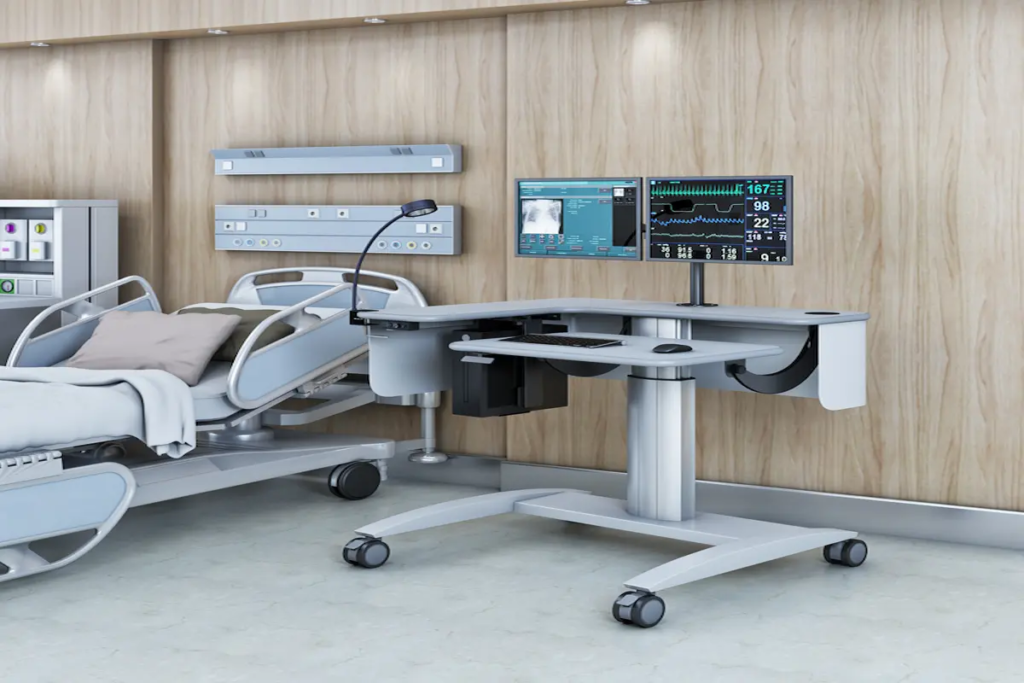
Ventilator Carts for Critical Care: The Safety Specification Guide
|
⚡ Quick Summary • A ventilator cart is not a medical cart with a ventilator placed on top of it. It is a purpose-engineered platform whose load rating, brake mechanism, power architecture, cable and tubing management, and anti-tip geometry are all specified around the specific life-support device it carries. • The most critical specification on a ventilator cart is the brake. A cart that moves during active patient ventilation is a life-safety failure. The brake mechanism must be engageable by one person without bending, must hold under the lateral forces of an ICU bay environment, and must not be accidentally releasable. • Six deployment scenarios create six different specification requirements: ICU bedside, emergency deployment, inter-ward transfer, MRI-compatible transport, respiratory therapy pool use, and pandemic/surge deployment. The same cart cannot be optimal for all six. • MRI compatibility is a blanket specification requirement for any cart that may approach a scanner suite — not a component checklist. Every ferromagnetic element becomes a projectile near an active MRI. This includes wheel components, brake hardware, and frame fasteners. • AFC Industries PA supplies ventilator carts and critical care equipment platforms with documented load ratings and safety specifications. Use the product configurator or contact the team to discuss ventilator model specifications, deployment scenarios, and UPS sizing. |
What Is a Ventilator Cart and Why Is It Different from Other Medical Carts?
A ventilator cart is a mobile platform engineered to carry life-support equipment safely through clinical environments. The distinction from other medical carts is not about aesthetics or clinical purpose — it’s about engineering standards, because the consequences of a structural or mechanical failure on a ventilator cart are categorically different from the consequences of a failure on any other type of medical cart.
A documentation cart that tips over loses a laptop. A ventilator cart that tips over during emergency deployment loses the patient’s airway management. A brake that fails to hold on a documentation cart rolls into a wall. A brake that fails to hold on a ventilator cart during active patient ventilation disconnects the circuit. These are not equivalent risk categories, and they require different specification standards.
The Joint Commission includes medical equipment safety as a component of its Environment of Care standards, specifically requiring that medical equipment be appropriate for its intended use, maintained in safe working order, and documented. For equipment that directly supports life-sustaining functions, those documentation and maintenance requirements are subject to heightened scrutiny during accreditation reviews. A ventilator cart with an undocumented load rating or an unverified brake specification is a compliance risk as well as a safety one.
This blog covers the engineering and safety specification dimension of ventilator carts that the previous blogs in AFC Industries PA’s healthcare cart series don’t address. Hygiene surface specification, antimicrobial technology, documentation workflow, telemedicine configuration, and tablet cart decisions all apply to general medical carts. Ventilator carts share those concerns but add a set of safety-critical engineering requirements that are unique to life-support equipment transport.
AFC Industries PA is a Pennsylvania-based workspace solutions specialist, independent from AFC Industries.
What Safety Specifications Does a Ventilator Cart Actually Require?
Most ventilator cart procurement conversations start at the wrong specification. Surface finish, storage capacity, wheel type — these are the visible attributes of any medical cart and they get discussed first. The safety-critical specifications — the ones whose failure has direct patient safety consequences — are structural load rating, brake mechanism, power architecture, cable and tubing routing, and anti-tip geometry. These need to be the first conversation, not an afterthought.
|
Safety Dimension |
Clinical Requirement |
Specification Standard |
Why Standard Products Fall Short |
|
Structural load rating |
Ventilator + monitor + accessories — typically 30–80kg total payload |
Minimum 1.5× rated load capacity of the total equipment weight; dual-column mechanism required above 40kg payload |
Most medical cart load ratings are tested to the rated load, not above it. For life-support equipment, demand a safety margin specification, not just the nominal rating. |
|
Brake lock mechanism |
Cart must remain stationary during active ventilation |
Dual-wheel brakes or all-four-wheel locking; brake must be engageable without bending; lockout mechanism prevents accidental release |
A ventilator cart that moves during active patient ventilation is a life-safety failure. The brake specification is the most critical safety component on the cart. |
|
Power architecture |
Uninterrupted power during transport and positioning |
Hot-swap or in-line UPS rated for ventilator electrical load; hospital-grade outlets (NEMA 5-20R or HG); outlet count for all connected devices |
A power interruption to a ventilator during patient transport is a patient safety event. Power architecture on a ventilator cart is a clinical safety specification, not a convenience feature. |
|
Cable and tubing management |
Ventilator tubing, power cables, monitoring leads |
Separate routed paths for electrical cables and respiratory tubing; no routing that creates kinking or occlusion risk in tubing; cable organisation that prevents accidental disconnection during movement |
Tangled respiratory tubing and power cables on a moving cart create disconnection risk. Organised, separated routing paths are a safety specification. |
|
Anti-tip geometry |
Lateral stability under emergency braking / fast movement |
Centre of gravity with full equipment payload must remain within the base footprint at maximum transport speed; anti-tip wheels at base rear |
A cart carrying a 60kg ventilator that tips over during emergency movement is a catastrophic equipment failure. Anti-tip geometry must be validated with the actual equipment payload. |
|
Surface and materials |
Clinical cleaning between patient uses |
Stainless steel or clinical-grade polymer; compatible with standard hospital disinfectants; no particle-shedding surfaces in ICU or respiratory environments |
Respiratory patients are among the most vulnerable to HAI. Cart surface specification follows the same principles as hygiene carts but with the additional constraint of NO surfaces that could shed particles into ventilator airway tubing. |
The power architecture dimension deserves specific emphasis because it is the most frequently under-specified safety feature in ventilator cart procurement. A power interruption to a ventilator is not a nuisance — it is a medical emergency. The UPS or in-line battery system that prevents that interruption during cart repositioning or brief disconnection from wall power is patient-safety infrastructure. It needs to be sized to the actual electrical load of the connected devices, tested regularly, and included in the biomedical equipment maintenance schedule.
How Do Ventilator Cart Requirements Differ Across Clinical Deployment Scenarios?
The single most common specification mistake in ventilator cart procurement is buying one product for all deployment scenarios. A ventilator cart that is optimal for a static ICU bedside position is a different engineering product from one that needs to cover emergency corridor deployment at speed. The table below maps six clinical deployment scenarios to the specific specifications each requires and the safety or operational rationale behind each requirement.
|
Deployment Scenario |
Movement Pattern |
Key Cart Specification |
Critical Safety or Operational Rationale |
|
ICU Bedside Station |
Static or near-static; ventilator rarely moves once placed |
Heavy-duty frame; all-four-wheel brake lock; large stable base; ventilator height-adjustable for clinician access from multiple sides of bed |
The cart lives at the bedside for the patient admission. Stability and clinician access geometry matter more than transport ease. |
|
Emergency Deployment |
Rapid movement from storage to patient bay |
Lightweight frame relative to payload; smooth-rolling casters over varied floor surfaces; single-person operable brake; fast equipment-connection system |
During an emergency deployment, the cart may be run at speed down a corridor. Anti-tip geometry and brake reliability are critical at movement speed. |
|
Inter-Ward Transfer |
Patient moving between ICU, HDU, theatre, imaging |
UPS sized for the transfer duration; caster type matching the range of floor surfaces between origin and destination; equipment secured for movement |
The power interruption risk is highest during inter-ward transfers. UPS sizing must cover the longest likely transfer time, not an optimistic estimate. |
|
MRI-Compatible Transport |
Patient needing imaging while ventilated |
Non-ferrous frame and components within MRI zone boundaries; aluminium or titanium construction; non-magnetic wheel components |
Standard steel carts cannot enter MRI suites. An unvetted ferromagnetic cart near an active MRI scanner is a projectile hazard. |
|
Respiratory Therapy Pool |
Multiple patients across ward; cart shared between patients |
Easy equipment connection and disconnection; accessible storage for circuit components; cleanable surfaces between patients; wheeled storage position |
Pool carts have higher surface hygiene demands because they cross between multiple patients. Between-patient cleaning protocol compatibility matters. |
|
Pandemic/Surge Deployment |
Rapid scale-up of ventilated patient capacity |
Standard modular configuration that can be replicated quickly; compatible with multiple ventilator models; documentation of configuration for non-specialist staff |
During surge events, non-specialist staff operate ventilator carts. Standardised, clearly documented cart configurations reduce error risk. |
What Are the MRI Compatibility Requirements for Ventilator Carts?
Any ventilator cart that may be used with a patient who requires MRI imaging while ventilated — or that is stored or transported through MRI zones as part of emergency response protocols — must meet MRI-conditional or MRI-safe specifications for all ferromagnetic components.
This is not a partial specification. A cart whose frame is aluminium but whose brake mechanism uses steel components is not MRI-safe. The magnetic field in an active MRI scanner does not distinguish between the frame and the brake. Any ferromagnetic component within the 5 Gauss line — typically extending well outside the scanner room itself — can become a projectile. A 60kg ventilator cart with ferromagnetic components within that zone is a potentially lethal hazard.
MRI-compatible ventilator carts require: aluminium or titanium frame construction; ceramic or polymer wheel bearings; non-magnetic brake components; and MRI-conditional certification on all attached monitoring and power equipment. These specifications add cost and reduce the available product range, but they are not optional for facilities where MRI transfer of ventilated patients is a clinical pathway.
How Do Monitor Carts and Monitor Stands on Wheels Integrate with Ventilator Platforms?
Patient monitoring in a ventilated patient environment involves multiple displays: the ventilator’s own control panel and waveform display, the patient monitor showing vital signs, and often a documentation terminal or EMR access point. How these displays are physically arranged around the patient directly affects how clinicians can see, respond to, and adjust them during intensive care.
|
Integration Dimension |
Clinical Standard |
What Goes Wrong Without It |
|
Patient monitor position |
At or slightly above nurse eye level at the bedside; visible from doorway and from both sides of the bed |
A monitor that can only be seen from one angle requires staff to reposition around the patient to read it — in an ICU bay, that creates physical access problems with other equipment. |
|
Ventilator control panel access |
At clinician working height — typically 90–110cm; not blocked by the monitor arm or cable routing |
Respiratory therapists need direct visual and manual access to the ventilator control panel without moving the cart or the patient. The monitor arm cannot obstruct that access zone. |
|
Monitor stand integration |
Monitor arm or monitor stand on wheels attached to or positioned alongside the ventilator cart |
Monitor stands with wheels that travel independently alongside the ventilator cart give more positioning flexibility in confined ICU bays than integrated single-unit carts. |
|
Cable and lead management |
Patient monitoring leads (SpO2, ECG, IBP) routed to not interfere with ventilator tubing or airway management |
In an ICU bay with a ventilated patient, the monitoring leads and the respiratory tubing occupy the same physical space around the patient. Routing discipline is a safety specification. |
|
Alarm visibility |
Monitor display visible to staff at the nursing station without entering the bay |
ICU workflow relies on nurses monitoring multiple patients simultaneously. A monitor positioned to only be visible from inside the patient bay is a monitoring failure waiting to happen. |
|
Documentation integration |
Computer or tablet access for real-time charting alongside monitoring |
Some ventilator cart configurations integrate a documentation terminal. Others pair with a separate mobile tablet cart or nurse station. Document the integration model in the cart specification. |
When Should a Monitor Stand on Wheels Travel Separately from the Ventilator Cart?
The integrated approach — where the patient monitor is mounted on the ventilator cart itself — is common in transport configurations because it reduces the number of separate pieces of equipment moving simultaneously. In static ICU bay configurations, a separate monitor stand on wheels often provides better positioning flexibility.
The integrated approach constrains monitor positioning to the geometry of the ventilator cart. A separate monitor stand on wheels can be positioned independently at the optimal viewing angle for both bedside clinicians and nursing station line-of-sight, while the ventilator cart sits in its optimal mechanical position relative to the patient’s airway. In a busy ICU bay where multiple pieces of equipment compete for positioning, that independence is a clinical workflow benefit.
AFC Industries PA supplies monitor stands on wheels and monitor carts that integrate with ventilator platform configurations. The ergonomic mounts range covers arm and monitor positioning solutions for critical care environments. The product configurator maps component compatibility across the full product range.
How Do You Specify the Right Ventilator Cart?
Ventilator cart specification is a patient safety exercise, not a procurement exercise. The six questions below are not generic best-practice suggestions — they are the minimum information required to specify a cart that is safe for the intended clinical use. Ordering a ventilator cart without answering all six is specifying by guess.
|
# |
Critical Specification Question |
What It Changes |
|
1 |
What is the exact make and model of the ventilator this cart will carry — and what does it weigh? |
Ventilator weights vary from 8kg (transport models) to 35kg+ (ICU units). The cart’s structural load rating, base configuration, and brake specification must be sized to the actual device, not a generic ‘ventilator.’ |
|
2 |
What is the deployment scenario — static bedside, rapid emergency, inter-ward transfer, or MRI? |
Each scenario requires different specifications. A static ICU cart and an emergency deployment cart are different products even if both carry the same ventilator model. |
|
3 |
What power load do the connected devices draw, and how long must the UPS cover? |
Calculate total wattage of ventilator + monitor + documentation terminal. Size UPS to cover the longest anticipated power-disconnected period with a 30% safety margin. |
|
4 |
Does the cart need to enter or approach any MRI suite? |
If yes, every metal component must be verified as non-ferromagnetic. This includes wheels, brakes, frame fasteners, and any attached equipment mounts. MRI compatibility is a blanket specification requirement, not a component checklist. |
|
5 |
What are the floor surfaces and doorway dimensions between the cart’s storage location and its deployment points? |
Emergency deployment routes cross multiple floor surfaces and may include narrow doorways, lift thresholds, and ramp transitions. The cart must be tested over the actual deployment route, not specified for the ICU floor only. |
|
6 |
Does the cart need to be operated by one person in an emergency, including brake engagement? |
Emergency deployment is a one-person task under time pressure. Brake mechanisms that require two hands or a specific orientation to engage are failures in that context. Specify foot-operated or single-hand brake engagement. |
What Is the Role of Biomedical Engineering in Ventilator Cart Specification?
The biomedical engineering department is the correct clinical authority for ventilator cart specification, not facilities management or general procurement. Biomedical engineers are responsible for the safety and maintenance of life-support equipment, understand the electrical safety standards (IEC 60601-1 series) that govern powered medical equipment, and are accountable for the equipment maintenance documentation that Joint Commission and accreditation reviews examine.
A ventilator cart specified without biomedical engineering input may meet general medical cart standards and still be inadequate for the specific ventilator model, power environment, or deployment scenario it will be used in. The procurement conversation for ventilator carts should include biomedical engineering from the initial requirements stage, not as a final sign-off step.
How Does Ergonomics Apply to Ventilator Cart Design in Critical Care Environments?
Critical care ergonomics has a different emphasis from general clinical ergonomics because the work is physically demanding, the environment is constrained, and the consequences of clinician error from fatigue or awkward posture are higher. Several specific ergonomic dimensions apply to ventilator cart design that standard medical cart ergonomics doesn’t fully address.
- Height of the ventilator control panel: Respiratory therapists adjust ventilator settings at the bedside, often while standing close to the patient and working around other equipment. The ventilator control panel needs to be at a height that allows accurate manipulation without sustained awkward posture — typically 90–110cm. Carts that raise the ventilator above this range to create storage underneath create an ergonomic problem at the most safety-critical interaction point.
- One-person manoeuvrability: ICU corridors and patient bay entries are constrained. A cart that requires two people to manoeuvre safely in those spaces creates a staffing dependency for every repositioning. Wheelbase, handle height, and turning radius all need to be validated for solo operation in the actual corridors and bay entrances of the facility.
- Emergency speed stability: During emergency deployment, a ventilator cart may be moved at near-running pace. The handle height, caster specification, and load distribution all affect stability at speed. A cart that handles safely at walking pace may be unstable at the pace of an emergency response.
- Brake engagement without interrupting care: In an ICU bay, the clinician engaging the cart brake is often simultaneously monitoring the patient or managing a procedure. A brake that requires a deliberate, two-handed, or specific-orientation engagement competes with patient care attention. Foot-operated single-action brakes that can be engaged without looking at the cart are the ergonomic standard for critical care.
What Do Ventilator Carts Cost?
Ventilator cart pricing is driven by structural specification, power architecture, brake mechanism type, and MRI compatibility requirements:
- Basic ventilator transport cart (rated 40–60kg, standard brake, cable management, no integrated power): $800–2,500. Suitable for low-frequency transport of portable ventilators where wall power is immediately available at the destination.
- ICU bedside ventilator cart (rated 60–80kg, all-four-wheel brake lock, integrated UPS 300–600Wh, monitor mount arm, cable management): $3,000–7,000. The appropriate specification range for static ICU deployment with integrated monitoring.
- Emergency deployment ventilator cart (rated 80kg+, foot-operated brake, hot-swap battery, anti-tip wheels, emergency rapid-deployment design): $5,000–10,000+. Purpose-engineered for rapid corridor deployment; prioritises stability at speed and one-person operation.
- MRI-compatible ventilator cart (aluminium/titanium frame, ceramic bearings, non-magnetic brake, full MRI-conditional certification): $8,000–20,000+. The cost premium reflects MRI-conditional component selection and the certification process.
- Custom OEM ventilator cart (specific ventilator model integration, full IEC 60601-1 documentation, biomedical engineering sign-off package): Project-specific. AFC Industries PA develops custom ventilator cart configurations with full safety documentation for facilities that require it.
The relevant cost comparison for ventilator cart procurement is the cost of a cart failure during active patient ventilation. That outcome is not quantifiable in the same terms as equipment replacement cost. The specification investment in a properly engineered ventilator cart is the risk mitigation against that outcome.
Conclusion: A Ventilator Cart Is a Life-Support Platform, Not a Medical Furniture Category
The engineering standard for a ventilator cart is set by the consequence of failure, not by the category of product it resembles. It resembles a medical cart. Its failure mode is a patient safety event in the category of life-support equipment failure. Those two facts require that it be specified, documented, and maintained as life-support equipment — not as medical furniture.
The brake holds or it doesn’t. The UPS covers the transfer or it doesn’t. The anti-tip geometry holds at emergency deployment speed or it doesn’t. The MRI-safe specification applies to every component or it doesn’t apply at all. These are binary safety requirements, not preference specifications. Getting them right the first time is the only acceptable approach.
AFC Industries PA is a Pennsylvania-based workspace solutions specialist, independent from AFC Industries. We supply ventilator carts and critical care equipment platforms with documented safety specifications to ICUs, emergency departments, and respiratory therapy units across Pennsylvania and the Mid-Atlantic region. For surface specification and hygiene, see the hygiene cart guide. For monitor stand on wheels configurations alongside ventilator platforms, see the mobile monitor stand guide. Explore medical carts, custom OEM builds, and industrial products. Use the product configurator, browse the full shop, or contact the engineering team to discuss ventilator model specifications, UPS sizing, and deployment scenario requirements. More about AFC Industries PA is on the About Us page.