
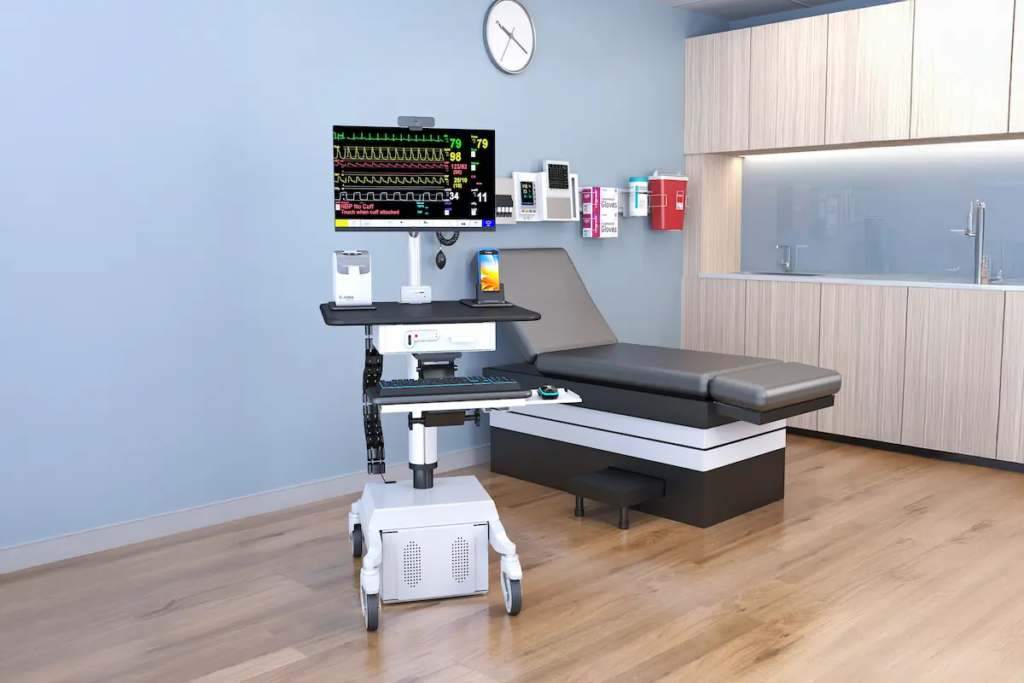
Cardiology Telehealth Carts: How to Configure a Telecardiology Workstation That Actually Works
|
⚡ Quick Summary • A cardiology telehealth cart is not a general telehealth cart with a cardiology label. It integrates specific cardiac diagnostic devices — ECG, echo, Holter, SpO2, BP monitor — with a teleconsultation platform in a single mobile configuration that supports clinical workflows from routine outpatient follow-up to acute chest pain pathway management. • The critical differentiator from general telemedicine carts is device integration: cardiac data must be visible to the remote cardiologist in real time, transmitted at diagnostic quality, and documented under HIPAA-compliant data governance. A standard telemedicine cart doesn’t address any of those requirements. • Six distinct telecardiology workflow types — remote ECG reading, virtual cardiology outpatient, remote echo review, acute chest pain pathway, post-discharge follow-up, and MDT collaboration — each require different cart configurations. A cart optimised for acute pathway speed is over-specified for routine follow-up and under-configured for MDT documentation. • The 10-minute door-to-ECG target in STEMI pathway management is a measurable performance standard. Every unnecessary connection step, software launch delay, or cable management failure on the cart contributes to missing that target. • AFC Industries PA supplies cardiology telehealth cart configurations with specific device integration for named cardiac equipment. Use the product configurator or contact the team to discuss your telecardiology platform, device payload, and workflow requirements. |
What Is a Cardiology Telehealth Cart and How Does It Differ from a General Telemedicine Cart?
A cardiology telehealth cart is a mobile clinical platform designed to support the specific diagnostic and consultation workflows of cardiology — not a generic telemedicine workstation applied to a cardiac setting.
The distinction matters because cardiology teleconsultation involves diagnostic data that general telehealth does not. A GP conducting a general telehealth consultation needs a camera, a microphone, a computer, and a reliable connection. A cardiologist conducting a remote consultation needs all of that, plus the ability to review a 12-lead ECG acquired at the patient’s location, view an echocardiography clip transmitted at diagnostic image quality, see real-time SpO2 and blood pressure alongside the video, and document the encounter in a system that meets cardiac registry and clinical governance requirements.
The American Heart Association’s Get With The Guidelines programme documents that timely access to cardiology specialist expertise — particularly for ECG interpretation in suspected STEMI — is directly correlated with patient outcomes. Telecardiology that uses a general telemedicine cart without ECG integration capability may provide a consultation but not the ECG-based specialist input that changes the care pathway. The cart configuration is a clinical capability decision.
This blog addresses the cardiology-specific dimension of telehealth cart specification that the general telemedicine cart guide doesn’t cover. Blog 28 in this series covers general telemedicine cart configuration for patient-facing consultations. This blog covers the cardiac device integration, telecardiology platform connectivity, acute pathway requirements, and data governance dimensions specific to cardiology.
AFC Industries PA is a Pennsylvania-based workspace solutions specialist, independent from AFC Industries.
What Does a Telecardiology Consultation Actually Require?
Telecardiology is not a video call with a cardiologist. At its most clinically valuable, it’s a synchronous or near-synchronous exchange of cardiac diagnostic data — ECG traces, echo clips, continuous monitoring data — between a patient location and a specialist, with the specialist providing real-time or time-limited interpretation that changes the management pathway.
The diagnostic data quality requirement is what makes telecardiology technically demanding. A 12-lead ECG transmitted as a photograph taken on a smartphone cannot be interpreted to diagnostic standard. An echo clip compressed for bandwidth and transmitted at low resolution cannot be reliably graded for wall motion abnormalities. A telecardiology consultation that uses substandard data transmission is a consultation whose clinical output cannot be trusted to the same degree as an in-person specialist review.
The American College of Cardiology’s telehealth guidance specifies that telecardiology services should maintain equivalent diagnostic standards to in-person consultation for the specific cardiac assessment being performed. That equivalence requires that the equipment — including the mobile cart from which cardiac data is acquired and transmitted — supports the technical standards required for diagnostic-quality cardiac assessment.
A 2021 study in the Journal of the American College of Cardiology found that telecardiology programmes with integrated diagnostic device transmission achieved specialist consultation response times an average of 47 minutes faster than programmes relying on physician transfer for specialist review. The cart configuration that enables real-time ECG transmission is what delivers that 47-minute reduction.
How Are Cardiac Diagnostic Devices Integrated into Telehealth Carts?
Cardiac device integration on a telehealth cart is the specification dimension that most separates a genuine telecardiology cart from a standard telemedicine cart with a cardiology application installed. Each cardiac device type has specific mounting, cable management, power, and connectivity requirements that must be addressed in the cart’s physical design. The table below maps the six primary cardiac device categories to their integration requirements and the clinical rationale behind each.
|
Cardiac Device |
Primary Clinical Use |
Cart Integration Requirement |
Configuration Rationale |
|
12-Lead ECG Device |
Resting ECG; ED chest pain pathway; pre-op cardiac screening |
Dedicated lead organiser and ECG device bracket; cable routing to prevent lead entanglement; compatible with ECG transmission software interface |
An ECG lead set tangled around a cart during an emergency acquisition slows the procedure and introduces artifact from lead contact instability |
|
Portable Echocardiography |
Bedside echo; point-of-care cardiac assessment |
Probe storage and charging dock; gel warmer mount; flat stable surface for the echo machine; cable length matched to echo probe reach from cart to patient |
Echo gel at room temperature affects patient comfort and image quality. The gel warmer needs to be accessible at the point of probe preparation, not across the room. |
|
Holter Monitor |
Ambulatory cardiac monitoring; 24-hour recording |
Holter device docking station for data download and review; patient-facing display for electrode placement guidance; printer mount for Holter report output |
Holter download and review is a documentation and communication workflow. The cart needs to support both the technical download and the remote specialist communication of results. |
|
Pulse Oximetry / SpO2 |
Continuous monitoring during consultation; post-cardiac event monitoring |
Clip-mount for SpO2 probe storage; monitoring lead routing integrated with ECG cable management; display position for simultaneous vital signs view |
In a telecardiology consultation, the remote cardiologist needs to see vital signs in real time. SpO2 and ECG display visibility to the camera is a configuration requirement. |
|
Blood Pressure Monitor |
Hypertension review; cardiac risk assessment consultation |
BP device bracket; cuff storage in accessible drawer; wired or wireless data link to documentation system; height-accessible for seated or standing patient |
Manual BP cuff application during a video consultation is a one-person procedure. The cart height and cuff storage position need to allow the clinician to access, apply, and read without leaving the patient’s camera frame. |
|
Telecardiology Software |
ECG transmission; remote reading; specialist collaboration |
Computer or secure tablet with telecardiology platform; dual screen (patient ECG view + consultation video); encrypted transmission capability for cardiac data |
Cardiac data transmitted over non-encrypted channels is a HIPAA violation as well as a clinical governance risk. The cart’s connectivity architecture must support encrypted clinical data transmission. |
What Is the Role of ECG Integration in a Cardiology Telehealth Cart?
ECG integration is the minimum viable capability for a telecardiology cart used in any acute cardiac pathway. A resting 12-lead ECG can be acquired in under two minutes by a trained nurse or paramedic. If that ECG is transmitted directly from the acquisition device to the remote cardiologist’s reading system, the specialist has diagnostic-quality data for STEMI decision-making within the same two minutes. If the ECG is printed, photographed, or manually entered into a separate system before transmission, the process adds five to fifteen minutes and multiple error opportunities.
Direct software integration between the ECG device and the telecardiology platform — without manual intermediary steps — is the standard that acute pathway performance targets require. The cart must physically accommodate the specific ECG device in use, with a dedicated bracket, organised lead storage, and a direct cable or wireless connection to the cart’s computer. This is a hardware and software specification, not a workflow policy.
What Telecardiology Workflows Does a Cardiology Telehealth Cart Support?
Not all telecardiology consultations have the same urgency, complexity, or technical requirement. A cart optimised for acute STEMI pathway management is over-engineered for routine post-discharge follow-up video calls, and a cart configured for routine follow-up is not fast enough for acute pathway deployment. The table below maps six distinct telecardiology workflow types to their configuration requirements and critical operational constraints.
|
Telecardiology Workflow |
Clinical Context |
Key Cart Configuration |
Critical Operational Note |
|
Remote ECG Reading |
Spoke hospital, GP clinic, urgent care |
ECG transmission to cardiologist at hub; real-time or store-and-forward; results returned within agreed SLA |
Key configuration: ECG device with direct software integration to telecardiology platform; no manual image capture or paper intermediary |
|
Virtual Cardiology Outpatient |
Hub hospital to patient at home or spoke clinic |
Synchronous video consultation; pre-loaded patient history visible to cardiologist; vital signs visible on camera if acquired at spoke location |
The cardiologist needs to see the patient, the vital signs, and the patient record simultaneously. Dual screen at the spoke site is the standard configuration for this workflow. |
|
Remote Echo Review |
Echocardiographer or reporting cardiologist at different site from patient |
High-quality image transmission of echo clips for remote reporting; voice or video concurrent review available |
Image quality is the primary constraint — echo clips transmitted at reduced resolution for bandwidth savings degrade diagnostic accuracy. Specify image quality settings before deployment. |
|
Acute Chest Pain Pathway |
ED to on-call cardiologist or regional cardiac centre |
Rapid ECG acquisition and transmission; patient history summary; real-time decision support for STEMI pathway activation |
Speed matters. The cart configuration must allow ECG acquisition and transmission within the 10-minute door-to-ECG target. Every extra cable connection or software step adds risk of missing the target. |
|
Post-Discharge Follow-Up |
Patient at home to outpatient cardiology service |
Video consultation; patient-reported symptom review; remote blood pressure or SpO2 review if home monitoring devices linked |
The follow-up consultation is lower acuity than acute pathways but higher volume. Cart efficiency matters more here than technical complexity. |
|
Specialist MDT Collaboration |
Multi-site cardiology MDT; heart team discussion |
High-definition video and image sharing across multiple sites; cardiac imaging visible to all participants; secure and documented discussion |
MDT documentation requirements under cardiac surgery protocols mean the telecardiology cart must support a documented, auditable session record. |
How Does the Cardiology Telehealth Cart Differ from General Telehealth Configuration?
The comparison below maps the key specification dimensions side by side. The right column is not simply an expanded version of the left — it represents a different product category that happens to share a cart chassis.
|
Configuration Dimension |
General Telehealth Cart |
Cardiology Telehealth Cart |
|
Camera position |
Eye-level mount for patient consultation |
Eye-level mount PLUS clear view of ECG lead and vital sign acquisition in the same camera frame |
|
Display configuration |
Single or dual screen for consultation + documentation |
Dual screen: (1) consultation video + (2) real-time cardiac data view (ECG trace, SpO2, vital signs) |
|
Audio |
Directional mic for voice only |
Directional mic PLUS audio quality sufficient for auscultation via digital stethoscope if integrated |
|
Device integration |
None beyond computer and peripherals |
ECG device, SpO2, BP monitor, Holter dock, echo machine interface — specific bracket and cable routing per device |
|
Connectivity / data security |
Standard clinical encrypted video |
Encrypted video PLUS encrypted cardiac data transmission compliant with HIPAA and local clinical governance |
|
Software integration |
EMR and telehealth platform |
Telecardiology platform with ECG viewer, image viewer, and MDT documentation capability |
|
Power |
Standard clinical UPS for session continuity |
UPS sized for computer, monitors, and all cardiac device power — larger power budget than standard consultation cart |
|
Physical footprint |
Compact consultation profile |
Wider to accommodate cardiac device storage without creating reach hazard; cable management for device leads critical |
What Data Governance Requirements Apply to Cardiology Telehealth Carts?
Cardiac data transmitted during a telecardiology consultation is Protected Health Information under HIPAA. That classification imposes specific technical requirements on the transmission infrastructure that general telemedicine carts may not address and that cart specifications frequently omit.
The HIPAA Security Rule requires that electronic PHI be transmitted using encryption standards sufficient to render the data unreadable to unauthorised interception. For cardiac data — ECG traces, echocardiography images, monitoring data — this means the cart’s connectivity architecture must support TLS 1.2 or higher for data in transit, with the telecardiology platform providing end-to-end encryption. A cart that transmits cardiac data over an unencrypted WiFi channel is a HIPAA violation and a regulatory liability, regardless of how clinically useful the consultation is.
- Access control: The cart’s documentation system must require authenticated access for sessions involving cardiac PHI. Shared login credentials that cannot be tied to a specific clinician’s identity do not meet HIPAA minimum necessary access standards.
- Audit logging: HIPAA requires an audit log of who accessed PHI, when, and what was transmitted. The telecardiology platform must maintain that log, and the cart must be configured to use only platforms that provide auditable session records.
- Session recording: Some telecardiology consultations — particularly MDT discussions involving patient-identifiable cardiac imaging — involve recording. The recording must be stored in a HIPAA-compliant system, not on the cart’s local storage.
- Physical security: A cart left unattended in a clinical corridor with an active session containing cardiac PHI is a physical security breach. Screen lock and auto-session-timeout are configuration requirements, not optional settings.
How Are Cardiology Telehealth Carts Used in Acute Cardiac Pathways?
The acute chest pain pathway is the highest-stakes telecardiology workflow and the one where cart configuration has the most direct impact on patient outcomes. The 10-minute door-to-ECG target for suspected STEMI is a documented quality metric with mortality implications. A 2019 study in Circulation found that each 10-minute delay in door-to-balloon time in STEMI patients was associated with a 7.5% increase in in-hospital mortality. The ECG acquisition and transmission step is a component of that timeline.
A telecardiology cart configured for acute pathway use needs to prioritise three things above all other specifications: speed of ECG acquisition and transmission, reliability of connectivity at the point of use, and one-person operability under time pressure. Any configuration complexity that adds steps between the patient arriving and the remote cardiologist receiving the ECG trace is a configuration failure in this context.
Specific acute pathway configuration requirements:
- Auto-launch telecardiology software: The platform should be ready to transmit without manual login steps at the point of ECG acquisition. Pre-authenticated session tokens with appropriate timeout are the standard.
- Wired ethernet at all acute deployment points: WiFi bandwidth degradation under clinical building load can cause transmission delays or failures at exactly the worst moment. Wired ethernet at every acute bay is the reliability standard for acute pathway ECG transmission.
- Single-connection ECG device docking: The ECG device should connect to the cart’s transmission system in one step. Multi-cable, multi-login, multi-step connection processes add time the acute pathway cannot absorb.
- Visible transmission confirmation: The clinician operating the cart needs to know the ECG has been received by the remote cardiologist, not just that it was sent. The cart’s display must show transmission confirmation before the clinical team moves to the next pathway step.
How Do You Specify the Right Cardiology Telehealth Cart?
The specification process for a cardiology telehealth cart requires more domain-specific input than most medical cart procurements — specifically, the input of the cardiology clinical lead and the IT/informatics team responsible for the telecardiology platform. Neither alone is sufficient.
|
# |
Specification Question |
What It Determines |
|
1 |
Which specific cardiac devices will this cart need to carry and connect? |
ECG, echo, Holter, SpO2, and BP monitors all have different mounting, cable management, and power requirements. Specifying ‘cardiac device compatible’ without naming the devices produces a cart that may not actually accommodate them. |
|
2 |
What telecardiology platform and data transmission standard are in use? |
Different platforms (Eko DUO, GE MUSE, Phillips IntelliSpace, bespoke hospital systems) have different connectivity, screen resolution, and encryption requirements. The cart must be configured for the actual platform, not a generic ‘telehealth compatible’ description. |
|
3 |
What are the bandwidth requirements at the deployment location for cardiac image transmission? |
Echo clip transmission at diagnostic quality requires significantly more bandwidth than standard video consultation. Verify bandwidth availability at the deployment site before specifying a wireless-only configuration. |
|
4 |
What is the door-to-ECG or door-to-data target for acute pathway workflows? |
If the cart will be used in an acute chest pain pathway, every additional setup step adds time against that target. Configuration must be optimised for rapid deployment: fewest connection steps, automated software launch, no manual data entry before ECG transmission. |
|
5 |
Does the telecardiology workflow require HIPAA-compliant or local equivalent data governance documentation? |
Cardiac data transmitted during remote consultation is PHI (Protected Health Information). The cart’s connectivity and software must support the documentation required by the facility’s data governance policy for remote cardiac data transmission. |
|
6 |
Will this cart be used by cardiology specialists, by general nurses at spoke sites, or both? |
A cart operated by a cardiologist at a hub site and a cart operated by a general ward nurse at a spoke site need different interface complexity. A spoke site nurse running a telecardiology consultation needs a simpler, more guided workflow than a specialist operating their own equipment. |
What Is the Role of Ergonomics in Cardiology Telehealth Cart Design?
Cardiology telehealth consultations can be technically demanding for the clinician managing the cart: acquiring an ECG while maintaining a video consultation, positioning monitoring leads while explaining the process to the patient, managing the display of cardiac data while addressing the remote cardiologist’s questions. That multi-task load makes ergonomic configuration more important, not less.
The specific ergonomic requirements for cardiology telehealth carts: work surface depth sufficient to accommodate cardiac device plus keyboard plus documentation space without cramping; cable management that keeps monitoring leads organised and accessible without creating a tangle that slows lead application; display height that shows the consultation video and cardiac data simultaneously without requiring the clinician to move their gaze significantly between them; and handle geometry that allows the cart to be repositioned by the clinician without releasing the monitoring connections.
AFC Industries PA integrates ergonomic mount systems and adjustable display configurations into cardiology telehealth cart builds. The product configurator maps device integration compatibility across the full AFC Industries PA product range.
What Do Cardiology Telehealth Carts Cost?
Cardiology telehealth cart pricing is driven by the cardiac device payload, telecardiology platform integration complexity, connectivity specification, and documentation requirements:
- Basic telecardiology cart (ECG device bracket + single screen + encrypted video capability + standard cable management): $2,500–5,000. Suitable for routine outpatient telecardiology and post-discharge follow-up at spoke sites.
- Mid-spec telecardiology cart (ECG integration + dual screen + SpO2 and BP device mounts + UPS + wired ethernet): $4,500–8,000. The appropriate specification for outpatient telecardiology services with integrated vital signs monitoring.
- Acute pathway telecardiology cart (ECG with direct platform integration + full monitoring device payload + rapid deployment configuration + HIPAA-compliant session management): $7,000–15,000+. Required for acute chest pain pathways and ED telecardiology deployment.
- Full telecardiology hub configuration (dual screen + echo viewer + MDT documentation capability + encrypted session recording + full cardiac device integration): $12,000–25,000+. For cardiology hub sites managing multi-site telecardiology programmes with echo review and MDT workflow.
- Custom OEM cardiology telehealth cart (specific device model integration + platform API connection + HIPAA audit documentation + IEC 60601-1 power safety): Project-specific. AFC Industries PA develops custom configurations for named cardiac equipment and telecardiology platforms.
The ROI frame for cardiology telehealth cart investment is the access improvement it delivers: a spoke hospital that can acquire and transmit a diagnostic-quality ECG to a cardiologist at a hub within ten minutes of patient arrival avoids both the mortality risk of delayed STEMI diagnosis and the clinical transfer cost of transporting patients for specialist review. AHA data on STEMI outcomes consistently shows the patient mortality reduction from timely specialist access as the quantifiable return on telecardiology infrastructure investment.
Conclusion: Telecardiology Is a Diagnostic Service, Not a Video Call Service
The distinction is worth being direct about. A general telehealth consultation delivers the specialist’s clinical judgment based on what the patient reports and what the clinician can observe on screen. A telecardiology consultation delivers the specialist’s clinical judgment based on diagnostic data — ECG traces, echo images, monitoring values — that is as close to the in-person diagnostic standard as the transmission infrastructure allows.
The cart configuration determines how close to that standard the telecardiology consultation actually gets. A cart with integrated, directly-connected ECG transmission that delivers a diagnostic-quality trace to the cardiologist within two minutes of acquisition is a clinical asset. A cart that requires the ECG to be photographed on a phone and attached to an email is a clinical compromise that adds time and degrades data quality at every step.
AFC Industries PA is a Pennsylvania-based workspace solutions specialist, independent from AFC Industries. We supply cardiology telehealth carts and telecardiology workstation configurations for outpatient, acute, and hub-site cardiac services across Pennsylvania and the Mid-Atlantic region. For general telehealth cart configuration, see the mobile hygiene stations and telemedicine cart guide. Explore medical carts, custom OEM builds, and ergonomic mounts. Use the product configurator, browse the full shop, or contact the team to discuss your telecardiology platform, device payload, and workflow configuration. More about AFC Industries PA is on the About Us page.