
Antimicrobial Medical Carts: What the Technology Actually Does — and What It Doesn’t
|
⚡ Quick Summary • Antimicrobial medical carts use surface treatments — silver ion, copper alloy, titanium dioxide, or embedded quaternary ammonium compounds — that inhibit bacterial growth between cleaning cycles. They are not a substitute for cleaning and do not guarantee a sterile surface. • Six antimicrobial technologies are used on clinical cart surfaces. Each has different regulatory status, efficacy range, and critical limitations. ‘Antimicrobial’ without the technology specified is a marketing claim, not a specification. • The most important misconception in antimicrobial cart procurement: an antimicrobial surface reduces bioburden between cleanings. It does not replace cleaning, does not kill viruses (most technologies), and does not remain effective indefinitely under clinical disinfectant exposure. • Antimicrobial specification should be matched to the infection acuity of the environment. ICU and critical care justify silver ion or copper-alloy on high-touch surfaces. Outpatient and community environments may not justify the cost premium of those technologies. • AFC Industries PA supplies antimicrobial medical carts with documented technology specifications and ISO 22196 test data. Use the product configurator or contact the team to discuss the right antimicrobial specification for your clinical environment. |
What Are Antimicrobial Medical Carts and Why Does the Technology Matter?
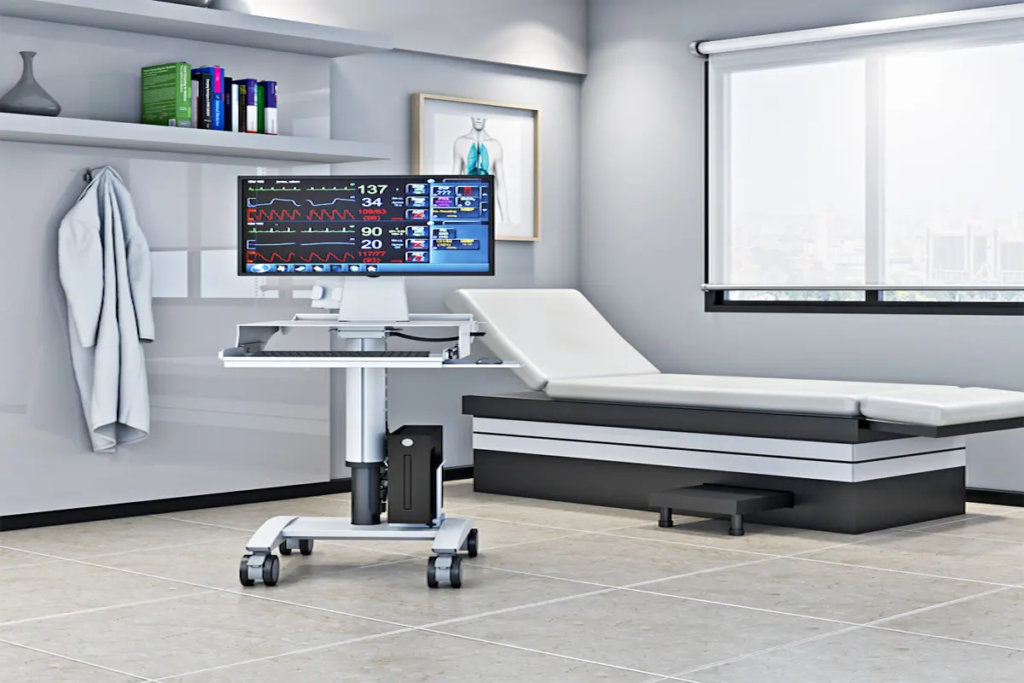
An antimicrobial medical cart is a mobile healthcare workstation whose surfaces incorporate materials or coatings that inhibit microbial growth between cleaning cycles. The distinction from a standard medical cart is not about cleanliness or hygiene — both types of cart need cleaning. It’s about what happens to microbial load on the surface during the intervals when cleaning hasn’t happened yet.
Clinical surfaces in healthcare environments accumulate bacterial contamination quickly. A study published in the American Journal of Infection Control found that high-touch healthcare surfaces can reach clinically relevant microbial counts within 15 to 30 minutes of cleaning on busy wards. For cart surfaces that are handled by multiple staff across multiple patients before the next scheduled cleaning cycle, that contamination accumulation is a documented transmission pathway.
Antimicrobial surfaces interrupt that accumulation. They don’t eliminate it — and that distinction matters for procurement and for infection control programme documentation. The US Environmental Protection Agency regulates antimicrobial surface claims in the US: surfaces can only make public health antimicrobial claims if they carry EPA registration, which requires demonstrated kill rates against specific pathogens under standardised test conditions. ‘Antimicrobial’ without EPA registration is a materials property description, not a public health claim.
This blog covers the technical dimension of antimicrobial cart specification that the other two guides in this series don’t. Our hygiene cart guide covers surface material specification and disinfectant protocol compatibility. Our clinic rolling cart guide covers documentation workflow and dual-monitor ergonomics. This blog covers the specific antimicrobial technologies, what they do and don’t do, and how to evaluate supplier claims rigorously.
AFC Industries PA is a Pennsylvania-based workspace solutions specialist, independent from AFC Industries. We supply antimicrobial medical carts with documented technology specifications and independent test data to healthcare facilities across the Mid-Atlantic region.
What Is the Most Important Misconception About Antimicrobial Medical Carts?
Facilities that procure antimicrobial carts and then reduce their cleaning frequency because ‘the surface is antimicrobial’ have misunderstood the technology and created a false sense of security that increases rather than decreases infection risk.
Antimicrobial surface treatments are designed to reduce microbial load between cleaning cycles — as an additional layer of protection on top of a cleaning protocol, not instead of one. This is the framing used in every peer-reviewed antimicrobial surface study and in EPA and MHRA guidance documents on the topic. The word ‘supplemental’ appears consistently.
The second common misconception is that antimicrobial means virucidal. Most antimicrobial surface technologies are bacteriostatic or bactericidal — they inhibit or kill bacteria. Very few have demonstrated efficacy against viruses. Silver ion and copper alloy surfaces have some published evidence for antiviral activity against specific viruses, but the data is not as robust as the antibacterial evidence, and most clinical antimicrobial surface specifications are based on bacterial pathogen reduction, not viral.
Understanding what the technology does and doesn’t do is essential for writing accurate infection control documentation. A facility that claims antimicrobial carts as part of its HAI prevention strategy needs to be able to describe exactly what protection the surfaces provide, under what conditions, and what cleaning protocol they supplement.
What Do Antimicrobial Cart Surfaces Actually Do — and What Don’t They Do?
The table below is the most practically useful reference for procurement decisions and infection control documentation. Both columns should be understood before specifying or approving antimicrobial carts for clinical use.
|
✓ Antimicrobial Surfaces DO… |
✗ Antimicrobial Surfaces DO NOT… |
|
Reduces microbial load on the surface between scheduled cleaning cycles |
Replace the need for routine surface disinfection — it doesn’t |
|
Inhibits bacterial growth during the intervals when cleaning hasn’t happened yet |
Kill all pathogens on contact or guarantee a sterile surface |
|
Reduce the risk of surface-to-hand-to-patient transmission on high-touch surfaces |
Provide protection against airborne or droplet transmission |
|
Support infection control protocols as an additional layer of defence |
Substitute for hand hygiene, PPE, or documented disinfection procedures |
|
Maintain lower bioburden on surfaces in high-touch clinical environments |
Self-report when they’re no longer effective — efficacy degrades and must be monitored |
|
Contribute to documented evidence of infection control measures for audit purposes |
Guarantee regulatory compliance on their own without other documented procedures |
The right-hand column deserves particular attention in procurement conversations. Suppliers whose antimicrobial cart descriptions don’t acknowledge these limitations are providing marketing material rather than technical specification. A specification suitable for infection control documentation should include both what the surface does and under what conditions its efficacy is maintained.
What Antimicrobial Technologies Are Used on Medical Cart Surfaces?
The term ‘antimicrobial cart’ covers products using six different surface technologies with different mechanisms, regulatory statuses, efficacy profiles, and critical limitations. Specifying one without knowing which technology it is and how it behaves under your cleaning protocol is the procurement equivalent of specifying ‘medication’ without knowing the drug, dose, or indication.
|
Technology |
Regulatory Status |
How It Works |
Critical Limitation |
|
Silver Ion (Ag+) |
ISO 22196 tested; EPA registered in many products |
Continuous bacterial inhibition between cleaning cycles; proven against S. aureus, E. coli, MRSA |
Does not replace cleaning. Silver ions are depleted over time — surfaces need periodic reactivation or replacement. Not virucidal. |
|
Copper Alloy Surfaces |
EPA-registered as antimicrobial; kill-time tested |
Kills 99.9% of bacteria within 2 hours of contact; self-sanitising between cleaning cycles |
Higher cost; copper tarnishes and requires specific compatible cleaning agents; not all cart components can be copper-alloy. |
|
Triclosan Impregnated Plastic |
FDA banned triclosan in many US consumer products |
Previously common in healthcare plastics; actively inhibited microbial growth in surface material |
FDA removed triclosan from OTC products in 2017; check compliance status of any cart claiming triclosan antimicrobial properties. |
|
Titanium Dioxide (TiO₂) Coating |
Photocatalytic; activated by light |
Oxidises organic matter including bacteria and viruses when exposed to UV or ambient light |
Efficacy depends on light exposure — less effective in dark storage areas. Not a standalone antimicrobial strategy in low-light environments. |
|
Zinc Pyrithione |
Used in coatings and polymers; EPA registered |
Antifungal and antibacterial properties; used in paint coatings and some cart surface treatments |
Lower activity against Gram-negative bacteria compared to silver ion. Less documented for healthcare-specific pathogen resistance. |
|
Quaternary Ammonium Compounds |
Embedded in surface material or coating |
Broad-spectrum antimicrobial; disrupts bacterial cell membrane; used in some clinical surface coatings |
Efficacy can diminish after repeated cleaning with incompatible agents. Verify compatibility with your facility’s disinfection protocol. |
Which Antimicrobial Technology Is Most Appropriate for Clinical Medical Carts?
For most acute inpatient clinical environments, silver ion technology in an ISO 22196-tested, EPA-registered surface material is the most practical specification. It delivers continuous bacterial inhibition, has the most robust clinical evidence base of any cart surface antimicrobial technology, and is available in laminate, polymer, and powder coat formulations compatible with most clinical disinfectants when correctly specified.
Copper alloy components — specifically solid copper or copper-nickel alloy surfaces, not copper-coated plastics — have the strongest evidence base for active pathogen kill rather than growth inhibition. The 2011 copper surface trial at MedStar Georgetown University Hospital found a 58% reduction in HAI rates in copper surface rooms compared to standard rooms. That evidence is compelling for ICU and critical care environments. It doesn’t necessarily justify the cost premium in outpatient or community settings.
Titanium dioxide photocatalytic coatings are an emerging technology with real potential in well-lit clinical environments but limited efficacy evidence in the low-light conditions common in patient rooms and storage areas. They’re worth monitoring as the evidence base develops but aren’t a first-choice specification for most acute clinical cart applications at present.
Which Cart Surfaces Should Actually Carry Antimicrobial Treatment?
This is the question most procurement processes don’t ask, and it matters because it directly affects cost and efficacy.
The surfaces that matter for antimicrobial specification are the high-touch surfaces — those that multiple people handle frequently and that are most likely to transmit contamination from surface to hand to patient. On a medical cart, those surfaces are: the handles (pushed and grabbed by every person who moves the cart), the keyboard and mouse surface (touched by every staff member who documents at the cart), and the work surface immediately adjacent to the keyboard and mouse.
The surfaces that matter less for antimicrobial specification but matter more for standard cleaning protocols are the frame, shelves, and lower surfaces. These accumulate contamination more slowly, are less frequently handled, and are cleaned in the routine surface wipe-down cycle. Specifying antimicrobial treatment on the whole cart rather than focusing it on the highest-contact components increases cost without proportionate infection control benefit.
A well-specified antimicrobial cart from AFC Industries PA targets antimicrobial treatment specifically to the high-touch surfaces. The medical carts range and custom products programme allow selective antimicrobial specification matched to the contact-frequency map of the target clinical environment.
How Should Antimicrobial Specification Be Matched to the Clinical Environment?
Antimicrobial specification is a cost-risk-benefit decision, not a universal standard. The infection acuity of the environment — the likelihood and consequences of HAI in that setting — should drive the specification level, not the availability of antimicrobial products or the desire to demonstrate infection control investment.
|
Environment |
Antimicrobial Specification |
Why It’s Justified Here |
Specification Caution |
|
ICU / Critical Care |
Silver ion or copper-alloy surfaces on high-touch components; stainless frame with fully sealed joints |
Continuous antimicrobial activity on high-touch surfaces is most valuable where cleaning intervals may be stretched by workload |
Copper alloy adds cost; specify where it’s justified by contact frequency, not across the whole cart |
|
General Medical Ward |
Silver-ion impregnated laminate or antimicrobial powder coat; sealed cable management |
Lower infection acuity than ICU but high cart mobility between bays means surfaces encounter many patients and staff |
Verify cleaning agent compatibility with the antimicrobial coating before specifying — some disinfectants reduce silver ion efficacy |
|
Outpatient / GP Clinic |
Antimicrobial laminate sufficient; standard disinfectant compatibility confirmation required |
Lower HAI risk than inpatient settings but high patient throughput; antimicrobial reduces between-patient bioburden accumulation |
Lower-specification antimicrobial acceptable; cost of silver ion or copper may not be justified for outpatient risk profile |
|
Pharmacy / Med Prep |
Antimicrobial surfaces on medication contact areas specifically; sealed drawer runners |
Medication contamination risk is the primary concern alongside general microbial control; contact surfaces matter most |
Full-cart antimicrobial spec may be over-specified; targeted antimicrobial on high-contact zones is more cost-effective |
|
Emergency Department |
Antimicrobial on keyboard and input device mounts specifically; durable coating rated for frequent cleaning |
ED carts encounter the widest patient acuity range and highest cleaning frequency — antimicrobial must survive aggressive cleaning |
Durability under high-frequency sporicidal cleaning matters more in ED than in lower-acuity environments |
|
Community / Home Care |
Antimicrobial laminate on work surface; minimal specification elsewhere; moisture-resistant construction |
Community carts enter domestic environments with unpredictable contamination profiles; low-grade antimicrobial adds useful baseline |
Don’t over-specify antimicrobial for community use — durability and portability matter more for this environment |
What Is the Role of Antimicrobial Carts in Hospital Computer Cart Fleets?
For hospital environments managing large computer cart fleets — hundreds of carts across multiple departments — the specification question becomes a portfolio decision rather than a single-product decision. High-acuity departments (ICU, HDU, surgical) warrant higher-specification antimicrobial technology. General wards and outpatient departments may justify a lower-cost antimicrobial specification. Administrative and non-patient-facing areas may not require antimicrobial specification at all.
Fleet antimicrobial procurement that applies the same specification uniformly across all departments is over-specifying in lower-acuity environments and potentially under-specifying in higher-acuity ones. A tiered antimicrobial specification, documented in the facility’s infection control policy, makes better use of procurement budget while focusing the highest protection where it delivers the most clinical value.
AFC Industries PA works with healthcare networks to develop tiered antimicrobial cart specifications for fleet procurement programmes. Contact the team to discuss fleet specification and volume pricing for multi-department deployments.
How Do You Evaluate Antimicrobial Medical Cart Claims?
The antimicrobial medical equipment market has a significant quantity of products making claims that are not supported by independent test data or regulatory registration. Knowing which questions to ask — and what a credible answer looks like — separates specification from marketing adoption.
|
# |
Question to Ask the Supplier |
What a Vague Answer Tells You |
|
1 |
What is the specific antimicrobial technology — silver ion, copper, quat, TiO₂? |
Generic ‘antimicrobial’ claims without specifying the technology cannot be evaluated, verified, or included in infection control audit documentation. |
|
2 |
Is the antimicrobial claim EPA-registered and independently tested to ISO 22196? |
ISO 22196 is the international standard for measuring antimicrobial activity on plastic surfaces. EPA registration is required in the US for legal antimicrobial claims. Without both, the claim is marketing, not specification. |
|
3 |
Which specific components carry the antimicrobial treatment — surface only, or frame and casters too? |
Many antimicrobial carts have treated work surfaces on non-treated frames and keyboards. The highest-contact surfaces in clinical use are often the handles and keyboards, not the work surface. |
|
4 |
What is the expected service life of the antimicrobial treatment? |
Silver ion concentrations deplete over time under cleaning agent exposure. Ask for the documented efficacy period and what the reactivation or replacement procedure is. |
|
5 |
Is the antimicrobial treatment compatible with your facility’s specific disinfectant agents? |
Some disinfectants chemically interact with antimicrobial coatings and reduce or eliminate their efficacy. Specify by agent name and request compatibility confirmation in writing. |
|
6 |
Can the supplier provide antimicrobial efficacy documentation suitable for infection control audits? |
Without independent test data, the antimicrobial feature cannot be included in a Joint Commission or CQC infection control evidence submission. Specify documentation requirements before ordering. |
How Do Antimicrobial Medical Carts Improve Efficiency and Workflow?
The workflow efficiency case for antimicrobial carts is secondary to the infection control case but worth addressing. The primary operational benefit is reduced between-patient wipe-down time in high-throughput environments where the cleaning protocol requires a full surface wipe between every patient interaction.
A cart with high-touch antimicrobial surfaces can, in lower-acuity outpatient environments with documented facility policy, reduce the wipe-down burden between patients compared to a non-treated surface cart, because the antimicrobial surface is doing ongoing contamination suppression work between wipes. This is not a substitution for cleaning — it’s a reduction in the urgency of the between-patient wipe in lower-risk settings that reduces time pressure on clinical staff.
In higher-acuity environments, the wipe-down protocol should not change regardless of antimicrobial surface specification. The antimicrobial provides supplemental protection; the cleaning protocol provides primary decontamination. Both are required.
What Do Antimicrobial Medical Carts Cost?
The cost premium for antimicrobial specification depends on the technology selected and which components carry the treatment:
- Antimicrobial laminate surface only (silver ion impregnated, ISO 22196 tested): $150–$400 premium over standard laminate on a standard cart, depending on surface area. This is the most cost-effective antimicrobial upgrade for general ward and outpatient environments.
- Antimicrobial powder coat on frame and shelves (silver ion or zinc pyrithione): $200–$600 premium depending on cart size and coating specification.
- Copper-alloy components (handles, keyboard surround, high-touch components only): $500–$2,000 premium for targeted copper alloy on the highest-contact surfaces. Full copper-alloy cart construction is significantly higher and rarely required outside ICU applications.
- Fully specified antimicrobial medical cart (silver ion surface, antimicrobial keyboard, sealed construction, EPA-registered documentation package): $2,500–$6,500 total depending on base cart specification. This is the appropriate specification range for acute inpatient environments.
- Custom antimicrobial OEM medical cart with tiered specification across fleet: Project-specific. AFC Industries PA develops fleet antimicrobial specifications with tiered pricing by department acuity level.
The cost comparison that matters: the CDC estimates the average cost of treating a healthcare-associated infection at $28,000–$33,000. A fully specified antimicrobial cart fleet in an ICU represents a small fraction of the cost of a single attributable HAI. That is the procurement justification frame, not unit price versus unit price.
Conclusion: Antimicrobial Is a Specification, Not a Label
Antimicrobial medical carts are a legitimate and evidence-supported component of a healthcare infection control programme — when the technology is specified correctly, documented accurately, and understood for what it does and doesn’t do.
A cart labelled ‘antimicrobial’ without a specified technology, without EPA registration or ISO 22196 test data, and without documentation of which components carry the treatment and under what conditions the efficacy is maintained is not an infection control tool. It’s a marketing descriptor applied to a product that may or may not behave differently from a standard cart.
The facilities that get value from antimicrobial cart investment are those that specify the technology, match the specification to the environment’s infection acuity, document the treatment as part of their infection control programme, and maintain the cleaning protocols that the antimicrobial surface supplements rather than replaces.
AFC Industries PA is a Pennsylvania-based workspace solutions specialist, independent from AFC Industries. We supply antimicrobial medical carts with documented ISO 22196 test data and EPA registration details to healthcare facilities across Pennsylvania and the Mid-Atlantic region. For surface material and disinfectant compatibility specification, see our hygiene cart guide. For documentation workflow and dual-monitor cart specification, see our clinic rolling cart guide. Explore medical carts, computer carts, and custom OEM builds. Use the product configurator to build a specification, browse the full shop, or contact the team to discuss antimicrobial technology selection for your environment. More about AFC Industries PA is on the About Us page.