
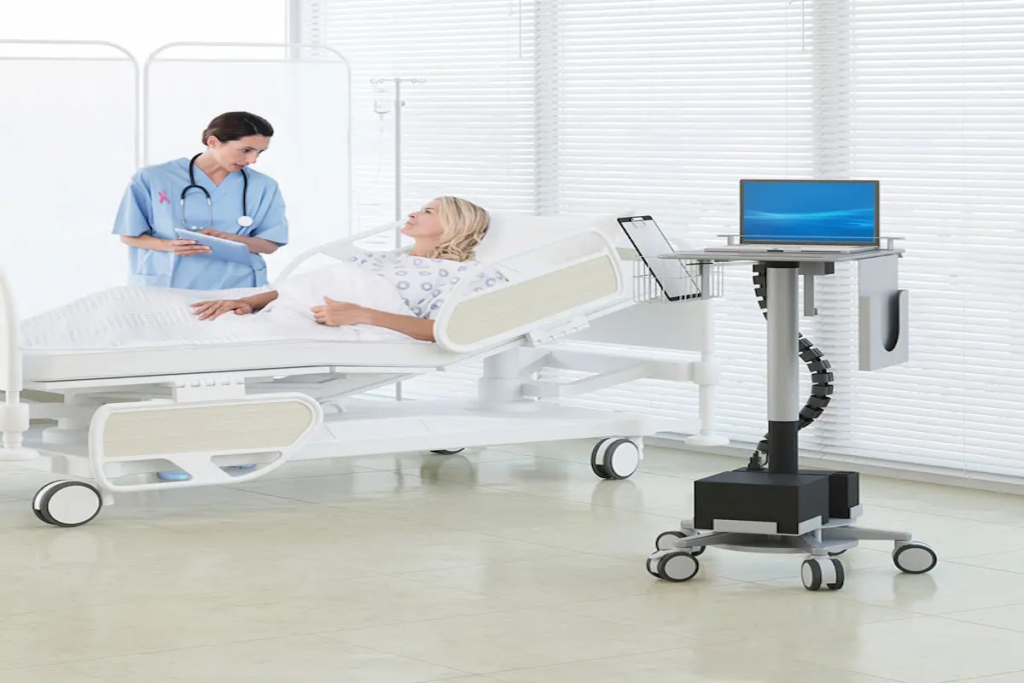
Telehealth Carts: From Pilot to Programme — Building a Scalable Virtual Care Infrastructure
|
⚡ Quick Summary • Most telehealth programmes move through five stages from ad-hoc to network-level service. The telehealth cart specification that’s appropriate at Stage 2 (pilot) is not the specification that works at Stage 4 (organisational) or Stage 5 (multi-site network). Building in scalability from Stage 2 costs less than re-specifying at Stage 4. • Platform standardisation is the single most important decision in telehealth cart programme scaling. Multiple platforms across departments multiply staff training cost, patient experience inconsistency, and IT support complexity. The cart hardware is secondary to the platform decision. • Six quality metrics should be tracked from the first operational day of any telehealth cart programme: session completion rate, technical failure type categorisation, cart setup time, patient satisfaction (technical), clinician-reported friction, and cart maintenance response time. • A telehealth cart programme without a documented maintenance and technical support model is not a programme — it’s a pilot that will fail at scale when the first critical cart goes down during a scheduled consultation session. • AFC Industries PA supplies telehealth carts and consultation with telehealth programme infrastructure planning. Use the product configurator or contact the team to discuss programme stage, platform requirements, and fleet specification. |
Why Is Telehealth Cart Specification Different at Scale?
A single telehealth cart in a single department is an equipment purchase. Twenty telehealth carts across eight departments connected to a multi-site specialist network is a clinical infrastructure programme. The equipment is the same category of product. The specification requirements, procurement logic, support model, and quality framework are entirely different.
The organisations that build successful telehealth programmes at scale are those that treated the infrastructure question seriously from the pilot stage — specifying for where the programme was going, not just where it was. The ones that struggled are those that bought the right cart for a pilot and then discovered, two years later, that their pilot-spec cart fleet couldn’t support EMR integration, had inconsistent video quality between departments, didn’t have documented maintenance procedures, and was technically obsolete in two of the specialist service expansions they were trying to add.
The US Department of Health and Human Services reports that telehealth utilisation remains at four times its pre-pandemic level. That volume is not supported by ad-hoc infrastructure. The organisations managing it at sustained quality are those with documented cart standards, platform governance, staff training frameworks, and quality metrics that operate continuously — not those with good intentions and improvised equipment.
This blog covers the programme-level telehealth cart dimension that the rest of the AFC Industries PA healthcare cart series doesn’t address directly. Blog 28 covers general telemedicine cart configuration for individual consultation rooms. Blog 32 covers cardiology-specific teleconsultation. This blog covers what happens when you’re building a service rather than configuring a cart.
AFC Industries PA is a Pennsylvania-based workspace solutions specialist, independent from AFC Industries.
What Are the Five Stages of Telehealth Cart Programme Maturity?
Telehealth programme development follows a recognisable pattern across different healthcare organisations and geographies. The stages are not inevitable — some organisations move through them quickly with good planning; others stall at Stage 2 for years because the infrastructure investment wasn’t made when the programme was small enough to make it cheaply.
Understanding which stage your organisation is at — and where the specification gaps are that will prevent you from reaching the next — is the most useful frame for telehealth cart procurement planning.
|
Programme Stage |
Description |
Telehealth Cart Implication |
What It Looks Like in Practice |
|
Stage 1: Ad-hoc |
Individual clinicians using personal devices or improvised setups |
No standardisation; dependent on individual clinician’s tech comfort; inconsistent patient experience; no quality metrics |
Laptop on a trolley, clinician holds a phone to show the patient. Common in 2020-2021. |
|
Stage 2: Pilot |
Structured pilot programme; 1–3 departments; standardised platform; basic cart specification |
Consistent platform; documented consent and governance; some quality monitoring; limited to pilot departments |
First dedicated telehealth carts; standardised video platform; basic IT support. Quality inconsistent between operators. |
|
Stage 3: Departmental |
Programme deployed across multiple departments; department-specific cart configurations |
Tiered cart specification by department type; staff training programme; platform integration with EMR; regular quality review |
Multiple cart types deployed; IT support structure in place; most technical failures resolved before affecting patient care. |
|
Stage 4: Organisational |
Telehealth service standard across the organisation; fleet specification; quality metrics in use |
Standardised fleet; documented SLAs for cart maintenance and technical support; patient satisfaction tracking; staff competency framework |
Organisation-wide deployment with consistent patient experience. Technical failures tracked and addressed within defined response times. |
|
Stage 5: Network |
Multi-site telehealth network; spoke-hub model; specialist teleconsultation across sites |
Network-level platform governance; cross-site cart compatibility; centralised technical support; specialist integration (cardiology, dermatology, psychiatry) |
Full teleconsultation service across multiple facilities. Cart specification supports both general telehealth and specialist consultation workflows. |
The transition from Stage 2 to Stage 3 is where most telehealth programmes fail or plateau. The pilot was successful, the department is happy, and there’s pressure to expand. But the expansion reveals that the pilot cart spec doesn’t work in other departments, the platform hasn’t been formally integrated with the EMR, no training programme exists for the new departments, and nobody owns the maintenance of the carts that are now deployed across the organisation.
The cost of solving those problems at Stage 3 is significantly higher than it would have been if they’d been included in the Stage 2 design. The cart specification is the visible part of the problem. The invisible part — platform governance, IT support model, staff training framework, quality metrics — is where the programme stalls.
Why Is Platform Standardisation the Most Important Telehealth Cart Decision?
The telehealth cart is hardware. The platform is the service. Getting the hardware right with the wrong platform is a solvable problem — the platform can be changed on existing hardware with some configuration work. Getting the platform right with the wrong hardware is also solvable — hardware can be upgraded. Having the right platform and the right hardware with inconsistent deployment across departments is the hardest problem to fix, because it requires retraining staff and reprocessing patient pathways.
Platform standardisation means one platform, one configuration standard, one training module, one IT support relationship, and one patient consent and governance framework across all telehealth cart deployments in the organisation. That single decision reduces training cost, patient experience inconsistency, IT support complexity, and data governance risk by more than any cart specification improvement.
The table below maps the key platform technical requirements to their cart implications and what goes wrong without each being specified. This is not a general IT specification — it’s the specific interaction between platform requirements and cart hardware and configuration.
|
Platform Requirement |
Technical Standard |
Cart Implication |
What Goes Wrong Without It |
|
Video Quality Minimum |
720p minimum; 1080p preferred for clinical consultation |
Cart camera must meet or exceed the platform’s minimum recommended camera spec |
A camera that produces adequate video on a consumer call looks inadequate in a clinical consultation room with variable lighting |
|
Bandwidth Requirement |
Minimum 5 Mbps upstream for 1080p video; 10 Mbps for dual-stream |
Wired ethernet connection on the cart is the reliability standard; WiFi acceptable as fallback only |
WiFi bandwidth at the deployment point may be adequate on average but degrade under building load during busy periods |
|
EMR Integration |
Single sign-on or pre-authenticated session for EMR access |
Cart’s computer must support the EMR’s browser or application requirements; screen resolution must render EMR clearly |
An EMR that doesn’t render correctly on the cart’s display resolution creates clinical documentation errors from misread fields |
|
Encryption Standard |
TLS 1.2 or higher for all data in transit; end-to-end for session content |
Cart’s network configuration must not route traffic through non-encrypted intermediaries |
Consumer video platforms (Zoom consumer, WhatsApp) do not meet HIPAA technical safeguard requirements without BAA |
|
Accessibility |
Platform must support closed captions for hearing-impaired patients |
Display resolution and caption positioning must render legibly on cart’s screen |
An accessibility requirement that the platform supports but the cart’s display doesn’t render correctly is a clinical governance gap |
|
Session Documentation |
Automated session logging with clinician ID, timestamp, and patient identifier |
Cart’s software configuration must enable audit logging without requiring manual data entry |
Manual audit log entry is inconsistently completed under clinical time pressure; automated logging is the operational standard |
How Should the Telehealth Cart Be Configured for the Selected Platform?
Platform configuration on a telehealth cart is not ‘install the software and connect a camera.’ It includes: screen resolution set to the platform’s optimum display dimensions for video rendering; camera driver configuration to the platform’s recommended frame rate; audio settings configured for the room acoustics of the consultation environment (not the default settings); network connection verified to the minimum bandwidth requirement at the deployment location, not the building average; and automatic platform launch on cart wake from standby so setup time is minimised.
Each of those steps is documented in the platform’s technical deployment guide. Most telehealth cart deployments skip some or all of them because the software ‘works’ when tested informally. The difference between ‘works when tested’ and ‘works reliably under clinical load every session’ is the configuration gap that produces the technical failures that erode patient and clinician confidence in the telehealth service.
AFC Industries PA configures telehealth carts to specific platform requirements before deployment. The product configurator is the starting point for mapping platform requirements to cart hardware specifications.
What Quality Metrics Should a Telehealth Cart Programme Track?
The most common quality management failure in telehealth programmes is tracking the wrong metrics. Organisations that track overall patient satisfaction without separating technical quality from clinical quality cannot identify whether a declining satisfaction score is caused by a clinical issue, a platform issue, or a cart hardware issue. The fix for each is different, and an aggregate score doesn’t tell you which fix to apply.
Six metrics, tracked from the first operational session, provide the quality information needed to manage a telehealth cart programme at any scale:
|
Quality Metric |
What It Measures |
How to Interpret It |
|
Session Completion Rate |
% of scheduled telehealth sessions completed without technical failure |
Target: >95%. Below 90% indicates a systemic equipment or connectivity problem. Below 80% means the programme is not functionally operational for patients. |
|
Technical Failure Types |
Categorised log of failure causes: dropped video, audio failure, equipment malfunction, connectivity loss |
Failure cause categorisation directs remediation to the right component. ‘Technical problems’ as a single category is unactionable. |
|
Cart Setup Time |
Time from entering consultation room to first live video connection |
Target: under 3 minutes for a trained user. Above 5 minutes consistently indicates a cart configuration or training problem. |
|
Patient Satisfaction (Technical) |
Patient-reported rating of technical quality in post-consultation survey |
Separate from clinical satisfaction. A programme tracking only overall satisfaction cannot identify whether poor scores are clinical or technical in origin. |
|
Clinician-Reported Friction |
Clinician-reported problems with cart or platform per session |
Collected in brief post-session report. Consistent reports of the same friction point (display visibility, audio delay, cable snagging) indicate a specification problem. |
|
Cart Maintenance Response Time |
Time from maintenance request to cart return to service |
Target: <4 hours for a critical cart (sole cart in a department); <24 hours for a fleet cart with spare coverage. Longer response times disrupt clinical scheduling. |
The session completion rate is the most immediately actionable metric. A programme with a completion rate below 90% has a systemic technical problem. The failure type categorisation is what directs the fix — if 70% of failures are connectivity related, the answer is wired ethernet at all deployment points; if 70% are audio failures, the answer is microphone specification; if 70% are cart setup time overruns, the answer is staff training or cart configuration simplification.
What Does a Telehealth Cart Maintenance Programme Look Like?
The maintenance question is the one most telehealth programme planners defer to later, and the deferral is the reason that ‘later’ typically involves a critical cart going down during a scheduled consultation block with no immediate resolution pathway.
A telehealth cart maintenance programme has four components:
- Preventive maintenance schedule: Regular checks — typically quarterly — of camera function, audio quality, connection reliability, height mechanism, brake, caster condition, and surface integrity. Documented and signed off by the responsible technical team.
- Reactive maintenance response model: Who receives a technical failure report, within what time they respond, with what spare coverage if the primary cart is out of service. A 4-hour response time for a sole cart in a department; 24-hour for a fleet cart with spare coverage is a realistic standard for a well-run programme.
- Software update management: Platform updates, operating system patches, and camera firmware updates need to be managed within a documented update window — not auto-applied during a clinical session. A platform update that changes the interface during a consultation block creates immediate usability problems.
- End-of-life planning: Telehealth carts have a realistic operational life of 5–7 years with maintenance. End-of-life planning — knowing when hardware will require replacement, maintaining budget for fleet renewal, and planning replacements in cohorts rather than individually — prevents the ad-hoc emergency replacement that disrupts programme continuity.
How Do You Scale a Telehealth Cart Programme from Pilot to Organisation-Wide?
The scaling question has an infrastructure answer and a change management answer. The infrastructure answer is the tiered cart specification, platform standardisation, and quality metrics framework covered above. The change management answer is harder and outside the scope of a cart specification guide — but the infrastructure answer creates the conditions under which the change management can succeed.
The six questions that determine whether a programme is ready to scale from pilot to organisational deployment:
|
# |
Programme Planning Question |
What It Prevents |
|
1 |
Is this a single-department deployment or a multi-department programme? |
Fleet procurement, tiered specification, central technical support, and standardised training are required from the first multi-department deployment. Adding them later is expensive. |
|
2 |
Which telehealth platform is standardised across the programme? |
Single platform across all departments creates consistent staff training, consistent patient experience, and a single IT support relationship. Multiple platforms multiply training and support cost. |
|
3 |
What is the maintenance and technical support model for the cart fleet? |
Identify: who responds to a cart technical failure, within what time, with what spare coverage. A maintenance model that depends on the clinician calling IT during a consultation is not a maintenance model. |
|
4 |
How will staff training and competency be documented? |
Telehealth programmes that lack documented staff competency cannot demonstrate to regulators that clinical governance requirements are met. Training completion logging is part of programme governance, not optional. |
|
5 |
What quality metrics will be tracked from day one? |
Metrics not established at programme launch are impossible to establish retrospectively for comparison. Session completion rate, technical failure categorisation, and patient satisfaction (technical) should be tracked from the first operational session. |
|
6 |
Is the cart specification compatible with future specialist service expansion? |
A programme that deploys general telehealth carts now and plans to add cardiology or dermatology teleconsultation in 18 months needs carts that can be upgraded with device integration, not replaced entirely. |
What Is the Role of Medical Computer Carts and Mobile Tablet Carts in a Telehealth Programme?
A scaled telehealth programme typically uses a mix of cart types across different deployment contexts within the same organisation. The full telehealth consultation cart — with integrated camera, dual screen, directional mic, and UPS — is the right configuration for dedicated virtual consultation environments. The mobile tablet cart is the right configuration for lower-acuity telehealth workflows — post-discharge follow-up calls, chronic disease check-ins, patient education — where the clinical requirement is video access rather than a full consultation environment.
Building that mix into the programme specification from Stage 2 — rather than discovering at Stage 3 that a full consultation cart is over-specified for 40% of the use cases — optimises total programme cost and matches cart quality to consultation type.
The AFC Industries PA healthcare cart series covers the full range. See Blog 29 on mobile tablet carts for lightweight telehealth deployment, Blog 28 on general telemedicine cart configuration, and Blog 32 on cardiology telehealth carts for specialist teleconsultation integration.
What Does a Telehealth Cart Programme Cost to Build and Scale?
Programme cost has two components: unit cost and programme cost. Unit cost is the cart hardware price. Programme cost includes cart hardware, platform licensing, IT support infrastructure, training development, and quality monitoring overhead. Most programme planning underestimates programme cost because only unit cost is visible in the initial procurement.
- Single consultation room telehealth cart (mid-spec): $3,500–6,500 for the cart hardware. Platform licensing, IT setup, and training overhead add 40–60% to the first-year total cost of deployment.
- Department-level pilot (4–6 carts, standardised platform, basic training programme): $15,000–40,000 for hardware. Programme costs (platform, IT, training, quality monitoring) typically equal or exceed hardware cost in year one.
- Organisational deployment (20–50 carts, tiered specification, full training programme, maintenance model): $70,000–$200,000 for hardware depending on tier mix. Volume pricing reduces per-unit cost significantly. Programme infrastructure investment is typically 50–80% of hardware cost in year one, declining to 20–30% annually thereafter.
- Network-level multi-site programme (50+ carts across multiple sites, specialist consultation integration): Programme-specific. AFC Industries PA develops programme-level telehealth cart specifications and fleet pricing for multi-site deployments. Contact the team for a programme scoping conversation.
The ROI frame for telehealth programme investment is access improvement: a patient who can see a specialist via a well-functioning telehealth service rather than waiting 6–12 weeks for an in-person appointment represents avoided cost to the healthcare system, avoided productivity loss to the patient, and avoided health deterioration from delayed specialist input. The telehealth cart is the hardware that makes that access real. The programme infrastructure is what makes it reliable.
Conclusion: A Telehealth Programme Is More Than Its Carts
The cart is the visible part. It’s what gets purchased, delivered, and pointed at during a quality review. But the programme that makes the cart deliver clinical value is the invisible part — the platform governance, the staff training, the quality metrics, the maintenance model, and the scaling infrastructure that determines whether the telehealth service works consistently for patients and clinicians or degrades under operational load.
Organisations that invest in both the visible and invisible parts from Stage 2 build telehealth programmes that reach Stage 4 and Stage 5. Organisations that invest only in the visible part build telehealth pilots that cycle through repeated restarts when the invisible problems surface.
AFC Industries PA is a Pennsylvania-based workspace solutions specialist, independent from AFC Industries. We supply telehealth carts and programme-level consultation for organisations building virtual care infrastructure. The full AFC Industries PA healthcare cart series covers the complete range: hygiene cart surface spec, rolling cart workflow, antimicrobial technology, telemedicine configuration, tablet carts, ventilator carts, cardiology telehealth, and department-by-department hospital cart spec. Explore medical carts and custom builds. Use the product configurator, browse the full shop, or contact the team to discuss your programme stage and scaling requirements. More about AFC Industries PA is on the About Us page