
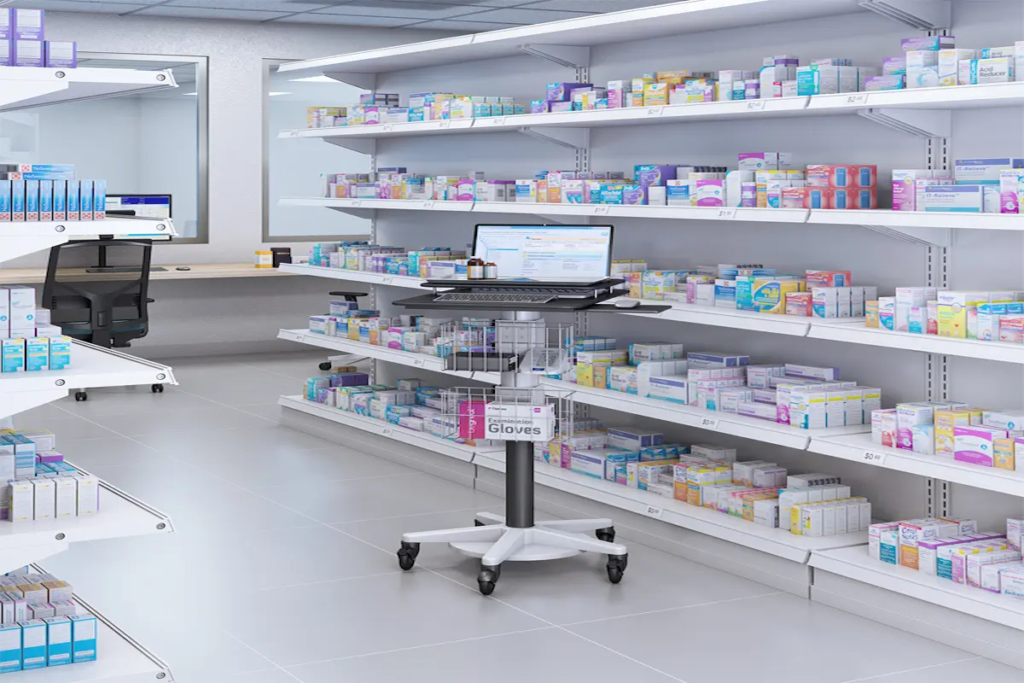
 Hygiene Carts Are Becoming Essential for Safer and Faster Healthcare Workflows
|
Quick Summary • Hygiene carts and medical computer carts are not interchangeable terms for the same product. A hygiene cart is specifically a mobile workstation whose surface specification, construction, and cable management are designed to survive the disinfection protocols of its clinical environment without degrading into a contamination source. • The disinfectant used in a department — IPA, quaternary ammonium, bleach, sporicidal agents, peracetic acid — is the single most important specification input. Wrong surface material for the cleaning agent turns the cart surface into a contamination pathway within months of deployment. • Six clinical workflows drive medical computer cart demand in 2026: EMR documentation, medication administration, telehealth, vital signs and diagnostics, mobile nursing stations, and patient intake. Each requires a different cart configuration. • Healthcare-associated infections (HAIs) affect approximately 1 in 31 hospital patients on any given day in the US, according to CDC data. Cart surface specification is a documented contributing factor in HAI investigations where contaminated equipment surfaces are identified. • AFC Industries PA supplies hygiene carts and medical computer carts with documented surface compatibility certifications. Use the product configurator to spec a configuration or contact the team to discuss your department’s disinfectant protocol and workflow requirements. |
What Is a Hygiene Cart and How Does It Differ from a Standard Medical Cart?
The terms get used interchangeably in procurement conversations, but they describe different levels of specification. A standard medical cart is a mobile workstation built for clinical environments. A hygiene cart is a medical cart whose design has been specifically engineered around the contamination control requirements of its environment — with surface materials, edge treatments, cable management, and construction that survive repeated disinfection without becoming a contamination source themselves.
The practical difference is visible within twelve months of deployment. A medical cart whose surface is laminate over an MDF substrate, with standard edge banding and exposed fasteners, will show edge delamination from repeated alcohol and disinfectant contact. Those delaminating edges become particle-trapping recesses that cleaning agents can’t reach. The surface that was supposed to support infection control becomes a contamination site.
The CDC’s Healthcare-Associated Infections data consistently shows that approximately 1 in 31 hospital patients acquire a healthcare-associated infection (HAI) on any given day. Equipment surfaces — including mobile workstations — are identified as contamination vectors in HAI investigations where surface cleaning protocols were followed but surface materials were not appropriate for the cleaning agents used. Cart specification is an infection control decision, not a procurement one.
AFC Industries PA is a Pennsylvania-based workspace solutions specialist, independent from AFC Industries. We supply medical computer carts and hygiene carts to hospitals, outpatient clinics, and healthcare networks across Pennsylvania and the Mid-Atlantic region, with surface material specifications documented to department-specific disinfection protocols.
Why Are Hygiene Carts Becoming More Important in Healthcare Infection Control?
The pressure on clinical infection control programmes has intensified since 2020. Facilities that weathered the COVID-19 response period found that their mobile equipment — carts, stands, shared workstations — was among the hardest surfaces to decontaminate reliably, because standard equipment wasn’t designed for the frequency and chemical intensity of the cleaning protocols applied during outbreak management.
The post-pandemic operational baseline is now a higher disinfection frequency and broader disinfectant spectrum than most mobile workstation equipment was originally specified for. The facilities that are ahead of this are those that have replaced equipment with surfaces rated for their actual cleaning protocol rather than a generic “clinical-grade compatible” claim.
The Joint Commission’s Infection Prevention and Control standards require healthcare facilities to document environmental cleaning procedures and the equipment used in clinical areas. A cart with a surface that degrades under the facility’s disinfectant protocol is a documented deficiency in the Joint Commission review process, not just an operational inconvenience.
The table below maps the six main clinical environments to their disinfectant protocols and the cart surface specification those protocols require. Most procurement conversations start at the cart. They should start at the cleaning agent.
|
Clinical Environment |
Disinfectant Protocol |
Cart Surface Specification |
Key Compliance Rationale |
|
General Ward / Outpatient |
IPA 70%, quaternary ammonium |
High-pressure laminate or powder-coated steel; sealed edges and joints; no exposed MDF substrate |
Daily wipe-down frequency; laminate must withstand 200+ cleaning cycles without edge delamination |
|
ICU / Critical Care |
Sporicidal agents, bleach, IPA |
Stainless steel 304 or 316L preferred; all joints welded or fully sealed; zero horizontal crevices |
Higher infection risk; surfaces must survive sporicidal agents without crazing, cracking, or delamination |
|
Surgical / Procedure Room |
Peracetic acid, glutaraldehyde |
316L stainless with electropolished finish; no polymer surfaces unless specifically rated for these agents |
Chemical aggressiveness eliminates most laminate options; stainless is the reliable baseline |
|
Pharmacy / Medication Prep |
IPA 70%, hydrogen peroxide |
Non-porous laminate or stainless; closed drawers with sealed runner channels; no exposed aluminium |
Medication residue contamination is the secondary risk alongside pathogen control |
|
Paediatric / Mental Health |
Hydrogen peroxide vapour, IPA |
Smooth radius corners; no exposed hardware edges; anti-ligature design on accessible surfaces |
Safety design requirements add to hygienic surface requirements — no sharp edges or attachment points |
|
Community / Home Care |
Basic disinfectant wipes, IPA |
Robust laminate or powder coat; moisture-resistant; easily wiped without specialist agents |
Lower disinfectant aggression but higher physical handling; durability and scratch resistance matter |
One specification point that consistently gets missed: the cable management system on a hygiene cart is as important as the surface material. Standard cable management channels have recesses, ventilation slots, and clip mechanisms that accumulate contamination between cleaning cycles. Sealed cable management — a conduit system with smooth exterior surfaces and no internal contamination traps — is a hygiene specification requirement, not an aesthetic one.
Why Does Mobility Matter in Modern Healthcare Workflows?
Healthcare professionals don’t work from a single location. A nurse on a 12-hour shift in an acute ward may cover the equivalent of four to five miles of floor movement, according to research published in the Journal of Nursing Administration. A significant portion of that distance is travelling to and from fixed workstations to document care that was just provided at the bedside.
The operational case for mobile medical carts is not about technology preference. It’s about where documentation happens relative to where care happens. When those two locations are the same — when the computer travels with the nurse to the patient rather than requiring the nurse to travel to the computer — documentation happens in real time, medication verification happens at the point of administration, and the number of trips to a fixed station drops substantially.
A 2019 study in the Journal of the American Medical Informatics Association found that point-of-care mobile computing reduced medication error rates by 27% in the study environment, and that nurses using bedside mobile workstations reported significantly less end-of-shift fatigue compared to those returning to fixed stations. Neither of those outcomes is primarily about the technology — they’re about where the workstation is positioned relative to the work.
AFC Industries PA’s medical carts and computer carts are built for clinical mobility requirements, with height adjustment, surface specifications, and caster configurations designed for the specific environments they serve.
What Clinical Workflows Do Medical Computer Carts Support?
The procurement mistake that produces the most operational problems with medical carts is specifying a single cart configuration for all clinical workflows. An EMR documentation cart and a medication administration cart look similar and can often be the same physical product — but they require different drawer configurations, different access control hardware, and different surface and cable specifications for the devices they carry. The table below maps the six primary healthcare workflows to their equipment requirements and cart configuration implications.
|
Clinical Workflow |
Equipment Required |
Cart Configuration |
Operational Impact |
|
EMR Documentation |
Computer, keyboard, mouse, barcode scanner |
Height-adjustable work surface; VESA monitor mount; sealed keyboard tray; power for computer and peripherals |
Very High — documentation lag at fixed stations is among the top reported workflow bottlenecks in acute care |
|
Medication Administration |
Medication storage drawer, scanner, computer |
Locked medication drawer; barcode scanner mount; clinical disinfectant-rated surfaces; auditable drawer access |
High — wrong-patient and wrong-medication errors are reduced when medication verification happens at the bedside |
|
Telehealth Consultation |
Camera, computer, display, microphone |
Stable platform for video equipment; cable management to prevent visible clutter during patient calls; adjustable height |
Medium-High — patient perception of professionalism affects telehealth adoption and satisfaction scores |
|
Vital Signs / Diagnostics |
Monitoring device, tablet or computer, printer |
Device mounting bracket for specific monitor brand/model; cable routing for probe sets; integrated power |
High — correct device mounting eliminates the improvised cable management that creates cross-contamination pathways |
|
Mobile Nursing Station |
Computer, printer, supplies, medication |
Multiple storage zones; separate clean/dirty organisation; height adjust for documentation and medication tasks |
Very High — consolidated point-of-care carts reduce the number of trips to fixed stations by the largest margin |
|
Patient Intake / Triage |
Computer, ID scanner, insurance reader, printer |
Accessible surface for patient documents; scanner reach zone; compact footprint for busy intake areas |
Medium — intake speed affects patient experience scoring and department throughput metrics |
How Are Medical Computer Carts Supporting Telehealth and Digital Care Workflows?
The shift to telehealth as a standard component of healthcare delivery — accelerated significantly from 2020 onward — created a new workstation requirement that standard medical carts weren’t designed for. A telehealth consultation requires a stable platform for a camera, a computer, a display large enough for the patient to see the clinician clearly, and a microphone, all configured in a way that presents a professional clinical environment to the patient on screen rather than the visual chaos of a busy ward behind the clinician.
The specific cart specifications this creates: camera mounting at a position that puts the clinician’s eye level in frame without requiring them to look down into a screen; display height that allows natural eye contact with the camera; cable management that eliminates visible wire tangles in the frame; and a surface that reads as clean and clinical in video rather than cluttered and improvised. These are new design requirements for a product category that existed before telehealth became standard, and they require purpose-built configuration rather than retrofitted standard carts.
Why Does Ergonomic Design Matter on Medical Computer Carts?
Musculoskeletal disorders are the most common occupational injury category among nursing staff. The Bureau of Labor Statistics consistently reports healthcare workers among the highest rates of work-related MSK injury in the US economy — higher than construction in some categories. A significant proportion of those injuries are caused by sustained awkward postures during documentation and equipment handling: bending over a cart that’s too low, reaching for a screen that’s too far away, twisting to access a drawer that’s positioned for right-handed use in a left-handed workflow.
An ergonomic medical cart is not one with an “ergonomic” label. It’s one where the height adjustment range covers the actual distribution of clinical staff who will use it, the monitor mount positions the screen at the correct eye level for documentation posture, the keyboard and input device sit at the correct wrist position for the operator’s height, and the storage layout positions frequently accessed items within reach without twisting or bending.
The height adjustment mechanism matters as much as the range. A mechanism that requires the operator to bend down to release a lever, grip a surface with both hands to lift, or call another person to adjust the height is a mechanism that doesn’t get adjusted between users. Which means it’s set for the last person who used it, and wrong for the current one.
AFC Industries PA integrates ergonomic mount systems into medical cart configurations where monitor and keyboard positioning needs to be independently adjustable from cart height — critical for carts shared between clinical staff and physicians who may have significantly different working heights.
How Do You Choose the Right Medical Computer Cart?
The procurement process for medical computer carts consistently fails at the same point: the decision gets made by someone who hasn’t asked the infection control team what disinfectant agents are used in the target department, and hasn’t documented the actual equipment payload the cart will carry. The result is a cart that looks appropriate, passes an initial review, and begins failing its clinical requirements within the first year of operation.
Six questions prevent that outcome:
|
# |
Question to Answer Before Specifying |
Why It Changes the Cart Completely |
|
1 |
What specific disinfectant agents are used in this department? |
This single question determines the surface material, edge treatment, and sealant specification. Don’t accept ‘clinical-grade compatible’ — ask for IPA, quaternary ammonium, bleach, sporicidal, or peracetic acid compatibility by name. |
|
2 |
What equipment will the cart carry, and what does each device weigh? |
The sum of device weights plus the cart’s own weight determines the caster load rating required. Undersized casters fail faster and generate particulates. Always include a 20% safety margin on the total payload. |
|
3 |
Who uses this cart, and what is the staff height range in this department? |
Height adjustment range must cover the actual distribution of users. Document the shortest and tallest staff who will use the cart and verify the adjustment mechanism covers that range. |
|
4 |
How far and how often does the cart travel per shift? |
A cart that crosses three departments per hour has different caster wear requirements from a cart that moves between two adjacent rooms twice a day. Movement frequency determines how quickly caster and mechanism specifications are tested. |
|
5 |
Does the cart need to carry medication, and if so, what are the access control requirements? |
Medication storage requires locked drawers with auditable access records in most clinical environments. The cart specification needs to include that hardware, not add it later. |
|
6 |
Will this cart be included in the facility’s infection control audit documentation? |
If yes, material certifications, surface disinfectant compatibility records, and construction documentation must be available from the supplier. Specify this before ordering. |
How to Choose the Right Medical Computer Cart: Step-by-Step
The six-step process below translates those questions into a specification order that produces a cart configuration correctly matched to its clinical environment:
|
Step |
Stage |
What to Do |
|
01 |
Define the workflow |
Map the clinical task the cart will support — EMR documentation, medication delivery, vital signs, or a combined mobile nursing station. The workflow determines the equipment payload, storage requirements, and ergonomic configuration. |
|
02 |
Identify the environment |
Note the department, disinfectant protocol, floor type, aisle width, and whether medication storage or access control hardware is required. |
|
03 |
Specify surface materials |
Match surface material to the disinfectant protocol. Use the surface specification table in this guide or ask the supplier to confirm compatibility with your specific agents by name. |
|
04 |
Size the casters |
Calculate total loaded weight (cart + all equipment + supplies) and add 20%. Specify caster type for the floor surface. Confirm sealed bearings and brake lock mechanism. |
|
05 |
Configure ergonomics |
Document the height range of staff who will use the cart. Confirm the adjustment mechanism covers that range. Specify monitor mount, keyboard tray, and device mounting positions for the workflow. |
|
06 |
Order with documentation |
Request material certifications, disinfectant compatibility records, and construction documentation at the time of order. These are needed for infection control audits and can’t always be retrieved after the purchase. |
How Do Medical Computer Carts Improve Efficiency and ROI?
The ROI case for well-specified medical carts has three components. The first is the avoided cost of HAI-related remediation. The CDC estimates the cost of treating a single healthcare-associated infection at between $28,000 and $33,000 depending on infection type. A contaminated cart surface that contributes to a single preventable HAI costs more than an entire fleet of correctly specified hygiene carts.
The second is staff productivity. The JAMIA study cited earlier found a 27% reduction in medication errors at point-of-care and significant reduction in end-of-shift fatigue with mobile bedside computing. Translating that into operational terms: fewer errors mean less rework, fewer incident reports, and less time spent on remediation. Less fatigue at end of shift means more accurate handovers and lower risk of errors in the final hours.
The third is equipment longevity. A cart with surface materials correctly matched to the disinfectant protocol lasts significantly longer without surface degradation, edge failure, or drawer mechanism deterioration from chemical exposure. The total cost of ownership of a correctly specified cart over five years is consistently lower than the total cost of replacing an incorrectly specified one twice in the same period.
What Do Medical Computer Carts and Hygiene Carts Cost?
Pricing is driven by surface material specification, height adjustment mechanism, drawer and storage configuration, access control hardware, and whether documentation packages are required. Realistic benchmarks:
- Standard mobile medical cart (powder-coated steel or laminate surface, manual height adjust, basic cable management): $800–$2,500. Suitable for general ward and outpatient environments with standard disinfection protocols.
- Hygiene-rated medical cart (stainless or disinfectant-rated laminate, sealed joints, enclosed cable management, sealed caster bearings): $2,000–$5,000. Required for ICU, surgical, and high-frequency disinfection environments.
- Medication administration cart (above plus locked drawer system, auditable access hardware, barcode scanner mount): $3,500–$7,000 depending on drawer count and access control specification.
- Full mobile nursing station (computer, storage, medication drawer, height adjust, ergonomic monitor mount, sealed cable management): $4,000–$9,000+ for a fully configured point-of-care workstation.
- OEM / custom medical cart build with material certifications and infection control documentation: Project-specific. AFC Industries PA provides full surface compatibility documentation for facilities requiring it. Contact the team for a scoped estimate.
The relevant comparison is not cart price versus cart price. It’s correctly specified cart total cost of ownership versus the combined cost of incorrectly specified cart replacement cycles plus any infection control remediation costs attributable to surface specification failures.
Conclusion: The Hygiene Cart Specification Starts with the Cleaning Agent, Not the Cart
Most medical cart procurement starts at the product and works backwards. A catalogue, a price, a surface finish that looks clinical. The disinfectant compatibility question comes later — often when the surfaces are already showing signs of degradation and the infection control team is asking questions.
The correct sequence runs the other way. Identify the disinfectant protocol of the target department. Specify the surface material that survives it without degradation. Build the cart configuration around the workflow it needs to support. Document the specification for infection control audit purposes. That sequence costs the same and produces a cart that performs correctly over its full operational life rather than failing its clinical requirements in year one.
AFC Industries PA is a Pennsylvania-based workspace solutions specialist, independent from AFC Industries. We supply hygiene carts, medical computer carts, and mobile clinical workstations with documented surface compatibility specifications to healthcare facilities across Pennsylvania and the Mid-Atlantic region. Explore medical carts, computer carts, and custom OEM builds. Use the product configurator to map a full cart specification, browse the full shop, or contact the team to discuss your department’s disinfectant protocol and clinical workflow requirements. More about AFC Industries PA is on the About Us page.