
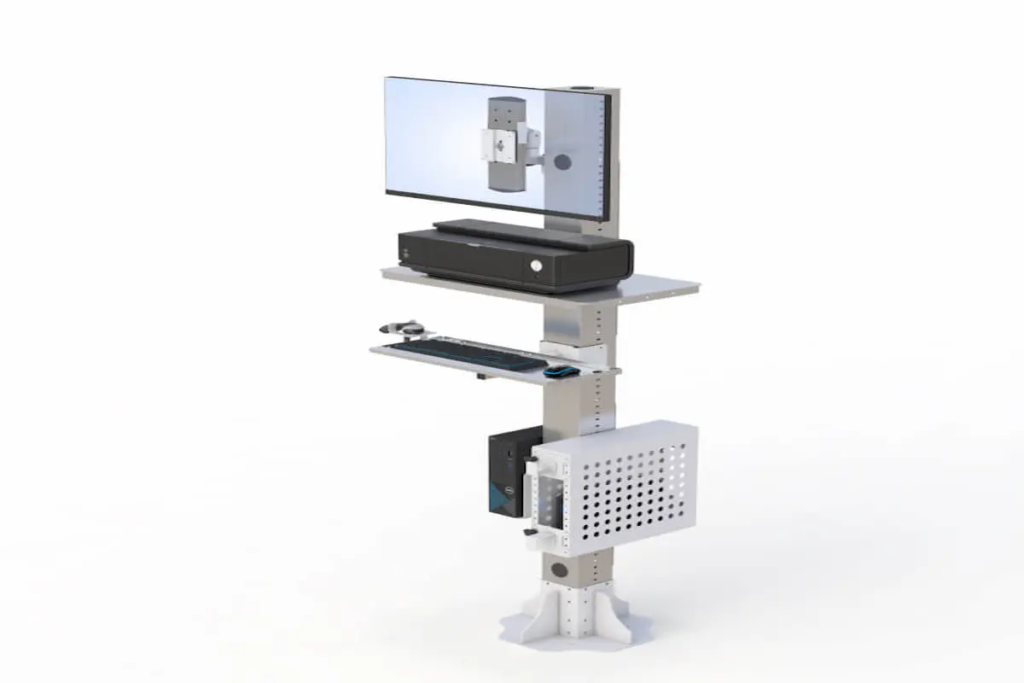
Cleanroom Computer Carts: How to Improve Mobility Without Compromising Compliance
|
⚡ Quick Summary • A cleanroom computer cart is not a standard computer cart with a wipe-down surface. Every component that contacts the floor, carries a cable, or moves against another part is a potential contamination source. The mobility itself is the engineering challenge. • The caster is the single most critical component specification in a cleanroom cart. Wrong caster material = particle generation on every rotation = contamination event with every move. Most buyers don’t check caster specification against ISO class. • Six mobility-specific contamination problems exist that fixed workstations don’t face: caster particle generation, floor turbulence, cable drag, static discharge, gowning breach risk from manoeuvring, and cross-contamination between zones. • Different industries have distinct mobility patterns — pharmaceutical Grade A rarely moves; medical device inspection carts move frequently; sterile processing carts move continuously between stations. The movement frequency changes the specification. • AFC Industries PA supplies ISO-rated cleanroom computer carts with documented caster specifications and material certifications. Use the product configurator to start a specification or contact the team to discuss your ISO class, floor type, and movement pattern requirements. |
Why Are Cleanroom Computer Carts Essential in Controlled Environments?
The fixed workstation problem in cleanrooms is straightforward: the work moves, but the workstation doesn’t. An operator who needs to document at the process point, or bring a barcode scanner to the sample, or reposition a computer closer to the instrument they’re operating, has two options — move themselves repeatedly, or use a mobile cart. In pharmaceutical and medical device environments, where every unnecessary step adds contamination risk and fatigue, a mobile cart that stays in the work zone rather than pulling the operator out of it is an operational and safety tool.
But introducing mobility into a cleanroom is not straightforward. Every component that moves — caster rotating against the floor, cable swaying during transit, cart frame vibrating over floor joints — generates particles. A cart that wasn’t designed for cleanroom use introduces contamination with every movement. The design challenge is not “how do we make this cart mobile” but “how do we make this cart mobile without generating particles above the classification limit at any point in its operating cycle.”
This blog covers the mobility engineering dimension of cleanroom cart specification. For the broader cleanroom workstation compliance framework, including ISO 14644-1 classifications, surface material specifications, and qualification documentation requirements, see our cleanroom computer workstation guide.
AFC Industries PA is a Pennsylvania-based workspace solutions specialist, independent from AFC Industries. We supply cleanroom computer carts to pharmaceutical, semiconductor, medical device, and life sciences facilities across the Mid-Atlantic region, with caster specifications documented to ISO class requirements.
What Are the Mobility-Specific Contamination Problems in Cleanroom Carts?
A fixed cleanroom workstation has one contamination challenge: the materials and construction of the unit itself. A mobile cart has six additional challenges that arise specifically from the fact that it moves. Each one has a specific engineering solution, and each one is a compliance risk if it’s not addressed in the specification.
|
Mobility-Specific Problem |
How It Occurs |
How Correct Cart Specification Prevents It |
|
Caster particle generation |
Wrong caster material sheds particles with every rotation, especially under load on rough-textured cleanroom floors |
Specify caster material to ISO class: polyurethane for ISO 6–7, stainless for ISO 1–5. Sealed bearings prevent lubricant shedding. |
|
Floor turbulence from movement |
Large caster profiles and wide wheelbase create turbulence at floor level in vertical laminar flow environments |
Low-profile cleanroom casters with smaller contact footprint minimise floor-level turbulence. Move carts during laminar flow reset cycles where possible. |
|
Cable drag during transit |
Unsecured cables drag on the floor as the cart moves, picking up floor contamination and depositing it at the new location |
Sealed cable management with minimum slack routing. Cable routing designed to accommodate maximum height adjustment without floor contact. |
|
Static discharge from movement |
Cart movement across cleanroom floors builds static charge that can attract particles onto surfaces or damage ESD-sensitive components |
Conductive or ESD-rated casters with grounded cart frame discharge static continuously during movement. |
|
Personnel gowning breach risk |
Moving a cart in a confined cleanroom aisle requires operator body movements that increase gowning breach risk |
Cart width, handle position, and turning radius all affect how much body movement is required to manoeuvre. Specify for the actual aisle dimensions. |
|
Cross-contamination between zones |
A cart that moves between cleanroom zones carries contamination from one area to the other on its surfaces and casters |
Zone-dedicated carts with documented transfer procedures. Caster boot covers or dunk trays at zone boundaries where protocol requires. |
The cross-contamination problem deserves specific emphasis because it’s the one most likely to be missed at the specification stage. A cart that moves between cleanroom classification zones — from ISO 7 to ISO 8, from aseptic to non-aseptic, from one product area to another in a multi-product facility — is a contamination transfer vehicle unless the movement protocol explicitly addresses decontamination at zone boundaries. The cart specification needs to include surface and caster materials that survive those decontamination procedures, not just the routine cleaning within a single zone.
What Is the Most Important Specification in a Cleanroom Computer Cart?
The caster. Not the surface material, not the frame construction, not the cable management — although all of those matter. The caster is the component that contacts the floor on every move, rotates against a hard surface under load, and has the largest surface area of any cart component in continuous contact with the controlled floor environment. It is also the component most frequently specified incorrectly because buyers focus on load rating and swivel radius rather than particle generation and chemical compatibility.
The table below covers the six caster types used in controlled environments, their ISO suitability, and the specific performance characteristics that determine whether each is appropriate for a given application. Standard black rubber casters are included specifically to document why they must never be used in any ISO-classified environment.
|
Caster Type |
ISO Suitability |
Key Specification |
Cleanroom Performance |
|
Standard Black Rubber |
Not suitable |
None — not cleanroom rated |
Sheds polymer particles, leaves black streaks on controlled floors, introduces contamination with every move. Do not use in any ISO class. |
|
ESD Conductive Rubber |
ISO 6–9 |
Anti-static compound, sealed bearing |
Eliminates static discharge risk in electronics manufacturing. Sealed bearing prevents lubricant particle generation. Suitable for mid-range cleanrooms. |
|
Polyurethane (cleanroom grade) |
ISO 5–8 |
Non-marking, sealed bearing, low outgassing |
Non-marking, very low particle generation rate, compatible with IPA and quaternary ammonium cleaning. Most common in pharmaceutical ISO 6-7 environments. |
|
Stainless Steel Wheel |
ISO 1–5 |
Electropolished SS, sealed precision bearing |
Extremely low particle generation. Used in the most stringent semiconductor and aseptic pharmaceutical environments. Expensive but required at high class. |
|
Nylon / Cleanroom Polymer |
ISO 6–8 |
Sealed bearing, chemical resistant compound |
Lightweight, chemical resistant, suitable for laboratory environments. Lower load rating than polyurethane options. Avoid if floor cleaning uses oxidising agents. |
|
Brake Lock Casters |
All ISO classes |
Material matched to environment class |
Required in any environment where a stationary cart must not roll during procedure or under vibration. Brake mechanism must be sealed — standard open brakes accumulate particles. |
Two caster specification points that commonly get missed: first, the bearing seal. An unsealed caster bearing generates lubricant particles as the lubricant breaks down under use. In ISO 5 and below environments, that lubricant particle contamination is a classification failure. Sealed precision bearings eliminate this particle source. Second, the brake mechanism. A standard open-lever brake creates a crevice that accumulates particles and resists cleaning. Enclosed brake mechanisms rated for the cleanroom class are required wherever carts need to be stationary during procedures.
What Features Make a Cleanroom Computer Cart Effective?
1. Cleanroom-Compatible Materials — Matched to Movement, Not Just Stationary Use
The material specification for a cleanroom cart that moves is more demanding than for a fixed workstation, for one reason: surfaces that are exposed to friction generate more particles than surfaces at rest. The wheel-to-floor contact, the cable-to-conduit interface, and the height-adjustment mechanism all involve moving surfaces. Each of those interfaces needs material specification that accounts for wear particle generation, not just initial surface composition.
316L stainless steel for pharmaceutical and biotech applications. Anodised aluminium for mid-range laboratory environments where weight matters. Cleanroom-grade polymer components — with outgassing certifications — for structural elements that aren’t load-bearing. And critically: no standard steel fasteners. Stainless fasteners throughout, or polymer-capped fasteners in lower-classification environments, because bare steel generates iron oxide particles as it oxidises under repeated cleaning agent contact.
2. Sealed and Enclosed Design
Every horizontal surface on a cleanroom cart that isn’t sealed at its perimeter accumulates particles between cleaning cycles. That includes shelf edges, the underside of work surfaces where they meet the frame, cable entry points, and the space around height adjustment mechanisms. The cleaning protocol can’t reach those accumulation points, so they become progressive contamination stores.
Sealed construction means edges welded or folded rather than butted and fastened, frame-to-surface joints sealed with cleanroom-compatible sealant rated for the cleaning agents in use, and height adjustment mechanisms enclosed within a column rather than exposed. The result is a surface map with no horizontal recesses — every surface either sheds contamination downward or is accessible to a cleaning cloth on a single pass.
3. Smooth Mobility with Controlled Movement
The mechanics of moving a cleanroom cart well are different from the mechanics of moving a standard cart. In a cleanroom, the operator is gowned, the aisles are narrower than office corridors, and the floor surface may be polished epoxy or raised-panel — both of which behave differently under a loaded cart than standard office carpet or vinyl.
Handle height and geometry affect how much operator body movement is required to initiate and control movement in a gowned suit. A handle at the right height allows straight-arm pushing without torso rotation. Too low and the operator bends forward, increasing gowning breach risk. Too high and pushing from the shoulders creates instability. Swivel radius and wheelbase affect turning in confined spaces — a cart that requires a wide turning arc in a narrow cleanroom aisle increases operator movement and therefore contamination risk at every transit.
AFC Industries PA’s computer carts and medical carts are available in cleanroom-rated configurations with handle geometry, wheelbase, and caster specifications matched to the mobility requirements of controlled environments.
4. Cable Management for Mobile Use
Cable management on a cart that moves has a requirement that fixed workstation cable management doesn’t face: the cable routing needs to accommodate the full range of height adjustment and directional movement without creating slack that contacts the floor, without exposing connectors to floor-level contamination, and without creating a snag point that pulls a device off the shelf during transit.
The correct specification is a sealed cable management column — integral to the cart’s height adjustment mechanism — that routes cables from the base power entry point to the work surface devices through an enclosed path. The column accommodates height changes by routing cables through a flexible sealed section rather than leaving them exposed outside the frame. At the floor level, the power entry point is elevated above the floor surface and sealed to prevent floor contamination from wicking up the cable bundle.
5. Ergonomic Adjustability for Operators in Gowning
Height adjustability on a cleanroom cart serves two purposes that standard cart adjustability doesn’t fully address. First, the same purpose as any ergonomic workstation: matching the working surface to the operator’s height to reduce fatigue and injury risk. Second, accommodating the reach and movement restrictions of cleanroom gowning, which changes the effective working height compared to ungowned operation.
A cleanroom-rated electric height adjustment mechanism needs to be enclosed within the cart’s column structure to prevent particle generation from the mechanism itself. Manual adjustment mechanisms that require the operator to grip and lift a component in a gowned suit are problematic both ergonomically and from a contamination standpoint — the grip contact and the lifting motion are both contamination risks in sensitive environments.
AFC Industries PA integrates ergonomic mount systems into cleanroom cart configurations where monitor and input device positioning needs to be independently adjustable from cart height.
6. Integrated Cleanroom Systems
A cleanroom computer cart operates as part of a system: it needs to be compatible with the fixed workstations in the zone, the mounting systems that hold equipment during transit, the power distribution that keeps devices operational between connections, and the documentation system that tracks cleaning and movement history.
AFC Industries PA builds cleanroom cart configurations that integrate with clean room workstation solutions, accessories, and custom products to create fully compliant mobile cleanroom ecosystems. The product configurator maps component compatibility across the full product range.
How Do You Choose the Right Cleanroom Computer Cart?
The specification process for a cleanroom computer cart has one step that most buyers skip: documenting the actual movement pattern the cart will follow before selecting materials. A cart that stays in one ISO zone with twice-daily cleaning has a different specification requirement from a cart that crosses zone boundaries four times per shift and gets cleaned at each crossing. The movement pattern determines the surface specification, the caster type, and whether decontamination procedures need to be built into the cart’s operating protocol.
Six questions determine whether the specification will hold up in practice:
|
# |
Specification Question |
Why It Determines the Cart Design |
|
1 |
What is the ISO classification, and does the cart move within one class or between classes? |
A cart that crosses zone boundaries carries contamination risks that a single-zone cart doesn’t. Document the movement pattern before specifying materials. |
|
2 |
What cleaning agents will be applied to this cart, and at what frequency? |
Surface material, sealant, and fastener specifications must all survive the actual disinfection protocol — not ‘standard cleanroom cleaning.’ |
|
3 |
What is the floor type and surface texture in the areas where the cart will operate? |
Rough epoxy floor coatings generate more particle friction than polished concrete. Caster hardness and profile need to match the floor specification. |
|
4 |
What is the total loaded weight of equipment the cart will carry? |
Caster load rating must cover the cart’s own weight plus the maximum equipment payload with a safety margin. Undersized casters fail faster and generate more particles as they degrade. |
|
5 |
What are the aisle dimensions and turning requirements in the facility? |
A cart that requires wide turns in narrow aisles increases operator body movement and gowning breach risk. Cart width and turning radius must be validated against the actual floor plan. |
|
6 |
Does the cart need to be included in the facility’s contamination control qualification documentation? |
If yes, material certifications, outgassing data, and construction records are required from the supplier. Specify this requirement before ordering. |
How Do Cleanroom Computer Carts Improve Efficiency and ROI?
The efficiency gain from cleanroom cart mobility is documented in the healthcare literature on point-of-care computing. A 2014 study in the Journal of the American Medical Informatics Association found that nurses using mobile computer carts at the bedside spent 41 minutes more per shift on direct patient care compared to those using fixed workstations, due to the elimination of workstation return trips. The same principle applies in pharmaceutical and medical device manufacturing: equipment brought to the process point eliminates the repeated travel between fixed stations that accumulates into significant time loss across a shift.
The ROI case includes a compliance dimension that’s specific to mobile cleanroom equipment. A correctly specified cleanroom cart that is included in the facility’s contamination control qualification documentation is an asset in regulatory inspections. An incorrectly specified cart that is identified as a contamination source during an FDA inspection or ISO audit is a liability that triggers remediation, re-validation, and potentially production shutdown. The cost difference between correct specification at purchase and remediation after audit consistently favours correct specification.
What Industries Benefit Most from Cleanroom Computer Carts?
The specific mobility requirements — how often the cart moves, what zones it crosses, what cleaning agents it encounters, and what equipment it carries — vary significantly across industries. The table below maps those mobility patterns and critical specifications for the six industries where cleanroom computer carts have the greatest operational impact.
|
Industry |
ISO Class |
Mobility Pattern |
Critical Cart Specification |
|
Pharmaceutical Mfg. |
ISO 5–7 |
Grade A/B areas: cart rarely moves during process; when moved, follows documented transfer procedure with surface wipe-down. Grade C/D: more frequent movement acceptable with cleanroom-rated casters. |
Surface material compatibility with IPA and sporicidal agents at every cleaning cycle. Sealed joints with no crevices that retain cleaning agent residue. |
|
Semiconductor Fab |
ISO 1–5 |
Carts move infrequently; stainless casters required; movement logged as part of contamination control documentation; airflow disruption from movement requires recovery time before process resumes. |
Anti-static grounding throughout frame and caster assembly. No outgassing materials anywhere in the cart — polymer components must have outgassing test certification. |
|
Medical Device Mfg. |
ISO 6–8 |
Higher movement frequency; carts bring inspection equipment to assembly points; height-adjustable for IPC-A-610 visual inspection tasks; brake locks engaged during inspection. |
ESD-safe surfaces for PCB and sensitive component handling. Cart frame and shelving must not generate metallic debris — sealed fasteners throughout. |
|
Life Sciences / Genomics |
ISO 5–7 |
Carts transport sample-handling equipment between preparation and analysis areas; cross-contamination prevention between samples is the primary concern beyond standard cleanroom compliance. |
Dedicated cart per workflow zone or documented decontamination procedure between zones. Smooth non-porous surface with no horizontal ledges that retain liquid sample spills. |
|
Hospital Sterile Proc. |
ISO 7–8 |
High movement frequency within SPD; carts transport instrument sets from washer to inspection to packaging to sterilisation; compatible with steam, enzymatic and peracetic acid cleaning. |
Stainless preferred throughout. No plastic components below load-bearing surfaces in high-temperature zones. Welded joints rather than bolted where steam cleaning is regular. |
|
Food / Beverage Lab |
ISO 8–9 |
Lower particle control requirement; primary contamination concerns are chemical and biological rather than particulate; carts move between prep areas and testing stations. |
Food-grade surface materials and sealants. Stainless or HDPE surfaces compatible with food industry sanitisers. No horizontal trapping surfaces that pool liquid. |
How Do Cleanroom Carts Support Compliance and Workflow Flexibility?
Compliance and flexibility are usually framed as competing demands in cleanroom environments. The regulatory standard requires controlled, documented procedures. Operational efficiency requires the ability to move equipment quickly where it’s needed. A correctly specified cleanroom computer cart resolves that tension by making the mobility itself compliant — so the flexible workflow doesn’t create compliance exceptions that need to be managed separately.
The documentation dimension is increasingly important. Modern contamination control programmes require that every piece of equipment in a classified environment has a documented specification and cleaning history. A cleanroom cart with material certifications from its manufacturer, caster specifications documented against ISO class requirements, and a cleaning log that integrates with the facility’s quality management system is a compliant piece of equipment. The same cart without that documentation is a compliance gap regardless of how well it was built.
What Do Cleanroom Computer Carts Cost?
Pricing is driven by ISO class requirement, caster specification, surface material, height adjustment mechanism, and whether documentation is included in the order. Realistic benchmarks:
- ISO 8 cleanroom cart (cleanroom-grade polyurethane casters, non-porous laminate surface, sealed cable management): $1,500–$3,500. Suitable for entry-level controlled environments including electronics manufacturing and food laboratory applications.
- ISO 6–7 pharmaceutical or medical device cart (316L stainless or ESD-safe surfaces, sealed bearing casters, enclosed height adjustment): $3,500–$8,000 depending on height range, payload capacity, and cable management specification.
- ISO 4–5 semiconductor or aseptic pharmaceutical cart (electropolished stainless, conductive casters, fully sealed construction, outgassing certification): $8,000–$20,000+. Required for the most stringent controlled environments; pricing reflects material and certification cost.
- Custom cleanroom cart build with full documentation package (material certifications, caster specification, IQ/OQ/PQ compatible records): Project-specific. AFC Industries PA provides full material and compliance documentation for facilities that require it. Contact the team for a scoped estimate.
The cost comparison that matters: a contamination event traced to an incorrectly specified cart — wrong casters for the floor, surface material incompatible with the cleaning agent, unsealed bearings generating lubricant particles — costs orders of magnitude more in production loss, re-validation, and regulatory response than the price difference between a standard cart and a correctly specified cleanroom one.
Conclusion: Mobility Is an Engineering Problem, Not a Procurement One
The cleanroom computer cart gets treated as a category of product rather than a specification challenge. Buyers search for “cleanroom cart,” find something that looks appropriate, and order it based on surface appearance and rough dimensions. The casters are wrong for the ISO class. The bearing seals aren’t rated for the cleaning protocol. The cable management creates a floor-contact risk during height adjustment. The contamination audit six months later finds all of it.
Specifying a cleanroom computer cart correctly requires knowing the ISO class, the movement pattern, the cleaning agents, the floor type, the loaded weight, the aisle dimensions, and whether the cart needs to be included in qualification documentation. That information is available before the order is placed. It costs nothing to document. And it eliminates the audit findings, the remediation costs, and the production risk that follow from getting the specification wrong.
AFC Industries PA is a Pennsylvania-based workspace solutions specialist, independent from AFC Industries. We supply cleanroom computer carts with documented caster specifications and material certifications to pharmaceutical, semiconductor, medical device, and life sciences facilities. Explore computer carts, medical carts, clean room solutions, and custom products. Use the product configurator to map a full specification, browse the full shop, or contact the team to discuss your ISO class and caster requirements. More about AFC Industries PA is on the About Us page.