
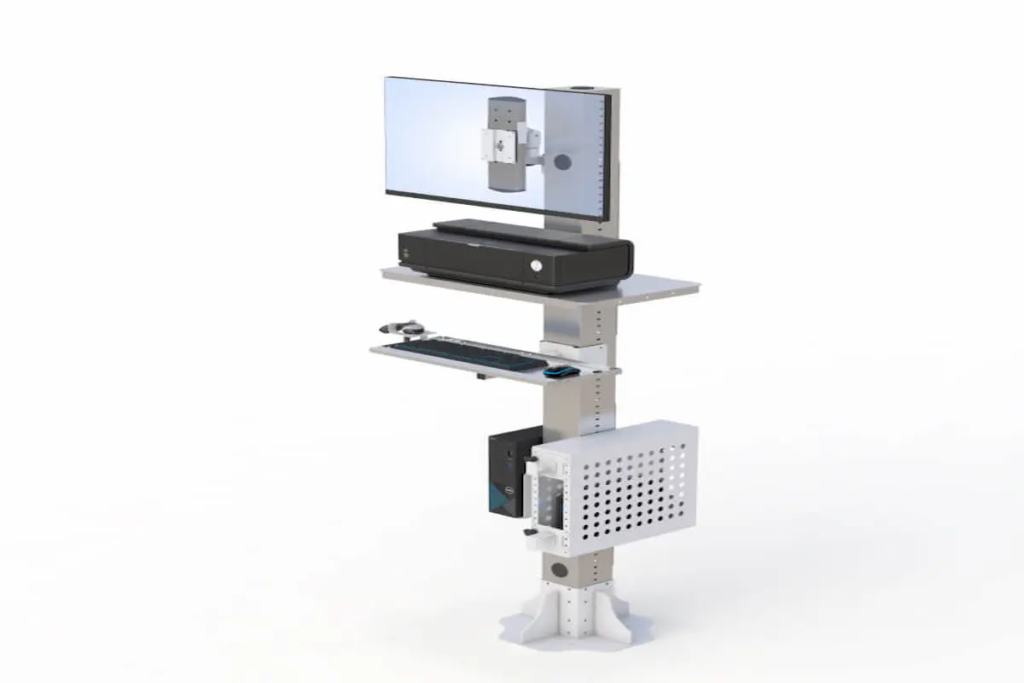
Clean Room Computer Workstations: How to Choose the Right Setup for Compliance and Efficiency
|
⚡ Quick Summary • A cleanroom computer workstation is not a standard workstation with a wipe-down surface. It is engineered to specific ISO classification requirements — controlling particle generation, supporting laminar airflow, and surviving the cleaning agents used in the facility without degrading. • The ISO classification of the environment determines the minimum material and construction standard for the workstation. A workstation suitable for ISO 8 is not compliant in ISO 5. Most buyers don’t check this. • Six features define a genuinely compliant cleanroom workstation: non-porous surfaces, airflow compatibility, minimal particle generation, sealed cable management, ergonomics for gowned operators, and integrated system compatibility. • Six industries have distinct cleanroom workstation requirements: pharmaceutical/biotech, semiconductor/MEMS, medical device manufacturing, genomics/life sciences, aerospace components, and hospital sterile processing. • AFC Industries PA supplies cleanroom-rated workstations and mobile carts with documented material certifications. Use the product configurator to start a specification or contact the team to discuss your ISO classification and cleaning protocol requirements. |
What Is a Clean Room Computer Workstation and Why Does It Matter?
A cleanroom computer workstation is a workstation built to operate inside a controlled environment without becoming a contamination source itself.
That distinction is more precise than it sounds. A standard workstation cleaned regularly is not a cleanroom workstation. It has particle-shedding joints, horizontal surfaces that accumulate contamination between cleaning cycles, cable bundles that trap particles and resist proper decontamination, and casters that leave polymer residue on controlled floors. Introducing that workstation into a cleanroom environment doesn’t make the workstation cleanroom-compatible — it makes the cleanroom less controlled.
The ISO 14644-1 standard classifies cleanrooms by the maximum allowable particle count per cubic metre of air. Those classifications impose specific requirements on every piece of equipment inside the environment — including workstations — because every surface, joint, and moving part is a potential particle source. A workstation that isn’t specified to the same standard as the room it operates in is a compliance gap, not just an equipment choice.
The cost of getting this wrong is not abstract. In pharmaceutical manufacturing, a contamination event traced to equipment not meeting cleanroom specification can trigger a batch recall, a regulatory inspection, and a production shutdown. In semiconductor fabrication, a particle on the wrong surface destroys a wafer that may represent thousands of dollars of processed material. The workstation specification is a risk management decision.
AFC Industries PA is a Pennsylvania-based workspace solutions specialist, independent from AFC Industries. We supply cleanroom-rated workstations and mobile carts with documented material certifications to pharmaceutical, semiconductor, medical device, and life sciences facilities across the Mid-Atlantic region.
What ISO Classifications Apply to Clean Room Workstations?
Before specifying any cleanroom workstation, you need to know the ISO classification of the environment where it will operate. That classification determines the maximum allowable particle count in the air, which in turn defines the minimum standard for every surface and component that can shed particles — including the workstation.
The table below maps ISO classifications to typical industries, particle limits, workstation material requirements, and the key constraint that most buyers miss when specifying at each level.
|
ISO Class |
Typical Application |
Particle Limit |
Workstation Material Requirement |
Key Constraint |
|
ISO 1–3 |
Semiconductor fab, MEMS |
≤10 particles/m³ (≥0.1μm) |
Fully sealed, electropolished SS, anti-static surfaces; no outgassing materials |
Most stringent — standard cart materials not suitable |
|
ISO 4–5 |
Pharma aseptic fill, biotech |
≤10,000 particles/m³ |
Non-porous laminate or SS, sealed cable routing, cleanroom-rated casters |
Workstation must not disrupt laminar flow pattern |
|
ISO 6–7 |
Medical device mfg, genomics |
≤1M particles/m³ |
Smooth non-shedding surfaces, stainless or ESD-safe materials, wipe-down rated |
Most common cleanroom range for healthcare-adjacent labs |
|
ISO 8 |
General electronics, PCB mfg |
≤100M particles/m³ |
Anti-static surfaces recommended; standard cart materials acceptable if surface-sealed |
Entry-level cleanroom; standard equipment often adapted |
|
ISO 9 |
Food processing, some labs |
Standard outdoor air quality |
Basic non-porous surfaces; primary concern is chemical and biological contamination |
Closest to standard workstation; surface material still matters |
The practical point that gets missed most often: cleaning a standard workstation regularly does not make it ISO-compliant. Compliance requires that the materials, joints, and moving parts of the workstation itself do not generate particles at a rate that exceeds the classification limit — and that the surface materials survive the cleaning agents used in that specific environment without degrading into contamination sources.
What Features Make a Clean Room Workstation Effective?
The features that matter in a cleanroom workstation are not the same features that matter in a standard ergonomic workstation. The primary question is not “will the operator be comfortable” — although that matters. It’s “will this workstation remain a compliant component of the controlled environment over its full operational life.” The table below maps each feature to the contamination problem it addresses.
|
Feature |
Contamination Problem Addressed |
Application Scope |
Compliance Impact |
|
Non-Porous, Cleanable Surfaces |
Particle accumulation and contamination pathways |
All ISO classes; surface spec varies by class |
Very High — wrong surface material invalidates cleanroom qualification |
|
Laminar Airflow Compatibility |
Workstation disrupts airflow and defeats HEPA system |
ISO 1–7 laminar flow environments |
Very High — obstructed flow creates contamination zones regardless of surface materials |
|
Minimal Particle Generation |
Workstation itself becomes a contamination source |
ISO 1–6 where outgassing and shedding are controlled |
High — frame, fastener, and caster materials all generate particles |
|
Sealed Cable Management |
Cables accumulate particles, snag on cleaning passes |
All cleanroom classifications |
Medium-High — cable bundles are a common contamination audit finding |
|
Ergonomic Design for Gowned Work |
PPE and gowning restricts normal reach and movement |
All cleanroom environments with full gowning protocols |
High — ergonomics in a cleanroom must account for restricted movement |
|
Integrated System Compatibility |
Workstation doesn’t fit with carts or existing mounts |
Full cleanroom builds across departments |
Medium — system coherence reduces maintenance and recertification complexity |
1. Non-Porous, Cleanable Surfaces
The surface material of a cleanroom workstation is not a cosmetic choice. It is a compliance specification. Porous materials — wood-core laminates, standard MDF-based surfaces, fabric panels — trap particles in surface irregularities that cleaning agents cannot reach, and they degrade under repeated application of the disinfectants used in controlled environments.
The correct surface materials for cleanroom workstations depend on the ISO class and the specific cleaning agents in use. Stainless steel (316L for higher classes, 304 for mid-range) is the most common choice for pharmaceutical and biotech applications because it is non-reactive, non-porous, and survives IPA, bleach, and sporicidal agents without surface degradation. High-pressure laminate over sealed substrate is acceptable for lower ISO classes where the surface is not exposed to aggressive disinfectants. Phenolic resin surfaces are used in laboratory environments with chemical exposure requirements.
The joint and edge treatment matters as much as the surface itself. A stainless-steel surface with unsealed edges or exposed fastener heads has particle-trapping points that fail cleaning audits regardless of the surface material specification.
2. Airflow-Compatible Design (Laminar Flow Support)
Laminar airflow systems work by maintaining a uniform directional flow of filtered air that sweeps particles away from the work surface and out of the controlled zone. A workstation placed inside a laminar flow environment without regard for its airflow footprint disrupts that pattern, creating turbulent zones where particles accumulate rather than exit.
The specific design requirements for airflow compatibility depend on the direction of the laminar flow — vertical (top-down, the most common in pharmaceutical and semiconductor environments) or horizontal (front-to-back, common in biological safety cabinets). For vertical laminar flow, the workstation needs open, unobstructed horizontal surfaces that don’t trap the downward flow. For horizontal flow, the workstation profile needs to be as shallow as possible from front to back to avoid creating a shadow zone behind it.
The casters of a mobile cleanroom workstation also affect airflow at floor level. Large solid caster profiles create turbulence where they contact the floor. Cleanroom-rated casters with smaller contact profiles and sealed bearing systems minimise this effect.
3. Minimal Particle Generation Construction
Every material in a cleanroom workstation generates particles. The question is how many, of what size, and whether that rate is compatible with the classification of the environment. The materials that generate the most particles in standard workstations — and that are therefore specifically excluded from cleanroom specifications — are exposed MDF, wood composites, fabric upholstery, and standard black rubber casters.
The materials that generate the least are 316L stainless steel (extremely low particle generation rate, non-outgassing), anodised aluminium (low rate, anti-static when specified), and cleanroom-grade polymers that have been tested for outgassing compliance. The fastener specification matters too: exposed thread fasteners shed metal particles and create cleaning recesses. Flush, sealed fasteners eliminate both problems.
4. Cable Management and Enclosed Systems
Cable bundles in cleanroom environments are a well-documented contamination audit finding. The exposed surface area of an unmanaged cable bundle accumulates particles efficiently, resists decontamination because the geometry prevents contact between cleaning agent and all surfaces, and creates mechanical turbulence in laminar flow environments if the cables move during operation or height adjustment.
Cleanroom cable management is not a cable tray. It is a sealed conduit system that routes cables from power source to device through an enclosed path, with access points sealed to the classification standard of the room. In mobile workstations, the cable routing needs to accommodate height adjustment without creating slack that forms loops on the floor — which both accumulates particles and creates a tripping hazard for operators in gowning.
5. Ergonomic Design for Long Shifts in Gowning
Ergonomics in a cleanroom environment has a constraint that standard office ergonomics doesn’t face: the operator is working in personal protective equipment. Full gowning — suit, gloves, hood, goggles, and overshoes — restricts movement, reduces proprioceptive feedback, narrows the field of vision, and reduces fine motor control. Every ergonomic specification that works at a standard workstation needs to be recalibrated for those constraints.
The practical differences: reach zone dimensions need to be tighter because glovework reduces reach accuracy; control surface areas need to be larger because gloved operation requires more surface contact to register reliable input; labelling needs to be higher contrast and larger because cleanroom goggles reduce visual acuity; and monitor positioning needs to account for the hood profile affecting the operator’s effective eye line compared to ungowned posture.
AFC Industries PA integrates ergonomic mount systems into cleanroom workstation builds with gown-adjusted ergonomic specifications for monitor positioning and input device placement.
6. Integrated System Compatibility
A cleanroom computer workstation doesn’t operate in isolation. It needs to integrate with the cart or base system that makes it mobile, the mounting system that positions screens and input devices, the power distribution that supplies the equipment, and the facility’s contamination control documentation system that records cleaning cycles and equipment qualification status.
AFC Industries PA builds cleanroom workstation systems by combining computer carts, medical carts, and custom products with cleanroom-rated surface specifications. The product configurator maps compatibility across the product range for facilities that need a fully integrated cleanroom workstation ecosystem.
How Do You Choose the Right Clean Room Workstation?
Most cleanroom workstation purchasing decisions go wrong at the same point: the buyer specifies a workstation that “looks right” or is labelled “cleanroom compatible” without verifying that it meets the specific ISO classification, survives the cleaning agents in use, and comes with documentation suitable for the facility’s qualification protocols.
Six questions determine whether a workstation will actually perform as a compliant cleanroom component:
|
# |
Question to Answer Before Specifying |
Why It Changes the Spec |
|
1 |
What is the ISO classification of the cleanroom where this will operate? |
ISO class determines allowable particle counts and therefore the minimum material and construction standard. A workstation specified for ISO 8 is not compliant in ISO 5. |
|
2 |
What cleaning agents are used in this environment? |
IPA, bleach, quaternary ammonium, sporicidal agents, and steam all interact differently with surface materials and adhesives. Specify material compatibility with the actual cleaning protocol, not a generic ‘cleanroom-compatible’ claim. |
|
3 |
Does the workstation need to be mobile, and if so, what are the caster requirements? |
Cleanroom-rated casters use conductive or anti-static compounds and have sealed bearings that don’t shed lubricant particles. Standard casters contaminate the floor and invalidate airflow patterns. |
|
4 |
Will operators be working in full gowning including gloves and goggles? |
PPE significantly restricts reach, grip, and field of vision. Ergonomic specifications for gowned cleanroom work differ from standard ergonomics — tighter reach zones, larger control surfaces, and higher contrast labelling. |
|
5 |
What are the power and cable requirements for the equipment this workstation supports? |
Sealed cable management with cleanroom-rated conduit prevents particle accumulation in cable bundles and eliminates the exposed horizontal surfaces that fail cleaning audits. |
|
6 |
Does this workstation need to be included in the facility’s cleanroom qualification documentation? |
If yes, the supplier needs to provide material certifications, outgassing test data, and construction documentation suitable for IQ/OQ/PQ validation protocols. |
How Do Cleanroom Workstations Improve Efficiency and Compliance?
The compliance improvement is direct: a workstation specified to the correct ISO class and cleaning protocol removes a contamination variable from the controlled environment. It doesn’t add particles at a rate that challenges the classification limit. Its surfaces survive the cleaning cycle without degrading into contamination sources. Its construction doesn’t create audit findings that require remediation.
The efficiency improvement is less obvious but equally real. A workstation that requires workarounds to be used in a cleanroom — additional sealing, cable improvisation, non-standard cleaning procedures — costs time in every cleaning cycle and introduces human error into a process that should be repeatable and documentable. A correctly specified workstation integrates into the cleaning protocol without exception handling.
The documentation dimension is increasingly significant. Regulatory bodies including the FDA (under 21 CFR Part 211 for pharmaceuticals and 21 CFR Part 820 for medical devices) and the European Medicines Agency require manufacturers to document contamination control measures in their production environments. A workstation with material certifications, outgassing test data, and construction documentation suitable for IQ/OQ/PQ validation protocols is not just a product choice — it’s a documentation asset.
What Industries Require Clean Room Computer Workstations?
Different industries operate under different ISO classifications, use different cleaning agents, and face different regulatory frameworks. The table below maps the specific workstation requirements and underlying compliance rationale for the six industries where cleanroom workstation specification has the most direct operational and regulatory impact.
|
Industry |
Typical ISO Class |
Workstation Specification Requirements |
Why the Spec Matters Here |
|
Pharmaceutical / Biotech |
ISO 5–7 |
316L stainless steel or non-porous laminate; no wood; sealed cable runs; 21 CFR Part 11 documentation compatibility |
FDA GMP compliance; batch record integrity; surface must withstand IPA and sporicidal disinfectants without degradation |
|
Semiconductor / MEMS |
ISO 1–5 |
Electropolished SS or cleanroom-grade polymer; fully anti-static; no outgassing; casters with conductive rating |
A single particle of the wrong size on the wrong surface destroys a wafer — the workstation is a contamination variable |
|
Medical Device Manufacturing |
ISO 6–8 |
Stainless or ESD-safe laminate; sealed joints; casters with brake locks; height-adjustable for IPC inspection tasks |
ISO 13485 and FDA 21 CFR Part 820 require documented contamination control in the production environment |
|
Genomics / Life Sciences |
ISO 5–7 |
UV-resistant non-porous surfaces; material compatibility with ethanol, bleach and quaternary ammonium compounds |
Cross-contamination between samples invalidates entire experimental runs; workstation surface spec is a data quality variable |
|
Aerospace Components |
ISO 6–8 |
Anti-static surfaces; sealed fasteners; no loose hardware; compatible with aerospace cleaning solvents |
FOD (Foreign Object Debris) control is a safety and compliance requirement; workstation construction must eliminate hardware shedding |
|
Hospital Sterile Processing |
ISO 7–8 |
Stainless steel preferred; no horizontal surfaces that pool water; compatible with steam, enzymatic and peracetic acid |
Inadequate surface spec in SPD is a direct patient safety risk — instrument reprocessing failures trace back to equipment design |
How Do Cleanroom Workstations Support Regulatory Compliance?
The regulatory frameworks that govern cleanroom environments each impose specific requirements on the equipment inside them, not just the room itself. Knowing which standard applies to your facility determines what documentation your workstation supplier needs to provide.
- FDA 21 CFR Part 211 (pharmaceutical manufacturing): Requires that equipment used in drug manufacturing is of appropriate design and materials to facilitate cleaning. Workstation material compatibility with cleaning agents must be documentable.
- FDA 21 CFR Part 820 (medical device manufacturing): Requires contamination control documentation in production environments. Workstation specifications must be included in Design History File and Device Master Record documentation where relevant.
- ISO 14644-1 (cleanroom classification): Defines particle count limits by class. All equipment in the environment, including workstations, must not generate particles at a rate incompatible with the room’s classification.
- EU GMP Annex 1 (pharmaceutical sterile manufacturing): Specifies surface finishes and construction requirements for equipment in Grade A-D environments. Workstation surfaces must meet Annex 1 finish requirements in classified areas.
- ISO 13485 (medical device quality management): Requires documented contamination control procedures. Workstation maintenance and cleaning records must be incorporable into the facility’s quality management system.
What Do Clean Room Computer Workstations Cost?
Cleanroom workstation pricing is driven by ISO class requirement, surface material specification, mobility requirements, and whether the build requires custom documentation for facility qualification. Realistic benchmarks:
- ISO 8 cleanroom workstation (non-porous laminate, sealed cable management, standard casters): $800–$2,500. Suitable for entry-level controlled environments with basic contamination control requirements.
- ISO 6–7 mobile workstation cart (stainless or ESD-safe laminate, cleanroom casters, sealed joints): $2,000–$6,000 depending on height adjustment mechanism and cable management specification.
- ISO 4–5 full specification workstation (316L stainless, electropolished, sealed fasteners, laminar flow compatible profile): $5,000–$15,000+. Required for pharmaceutical aseptic fill and semiconductor environments.
- Custom cleanroom workstation build with IQ/OQ/PQ documentation package: Project-specific. AFC Industries PA provides material certifications, construction documentation, and qualification support for facilities that require it. Contact the team for a scoped estimate.
The relevant cost comparison for cleanroom procurement is not workstation price versus standard cart price. It’s workstation price versus the cost of a contamination event caused by non-compliant equipment — which, in pharmaceutical batch production or semiconductor fabrication, can exceed the cost of the full cleanroom equipment programme many times over.
Conclusion: Cleanroom Workstation Specification Is a Contamination Control Decision
The cleanroom workstation gets treated as furniture in most procurement processes. It’s ordered after the room is designed, from whoever can ship the fastest, based on surface appearance and rough dimension fit. The contamination audit that follows — six months into production, after the first qualification review — finds the things that specification would have prevented: wrong casters, exposed fasteners, cable bundles that fail wipe-down, a surface material that degrades under the cleaning protocol.
Specifying correctly before ordering costs less than remediating after installation. It requires knowing the ISO classification, the cleaning agents, the mobility requirements, the ergonomic constraints of gowned operation, and whether the supplier can provide documentation that integrates with the facility’s qualification protocols.
AFC Industries PA is a Pennsylvania-based workspace solutions specialist, independent from AFC Industries. We supply cleanroom computer workstations and mobile carts with documented material specifications to pharmaceutical, semiconductor, medical device, and life sciences facilities across Pennsylvania and the Mid-Atlantic region. Explore clean room solutions, computer carts, and custom products, use the product configurator to start a specification, browse the full shop, or contact the team to discuss your ISO classification and qualification documentation requirements. More about AFC Industries PA is on the About Us page.