
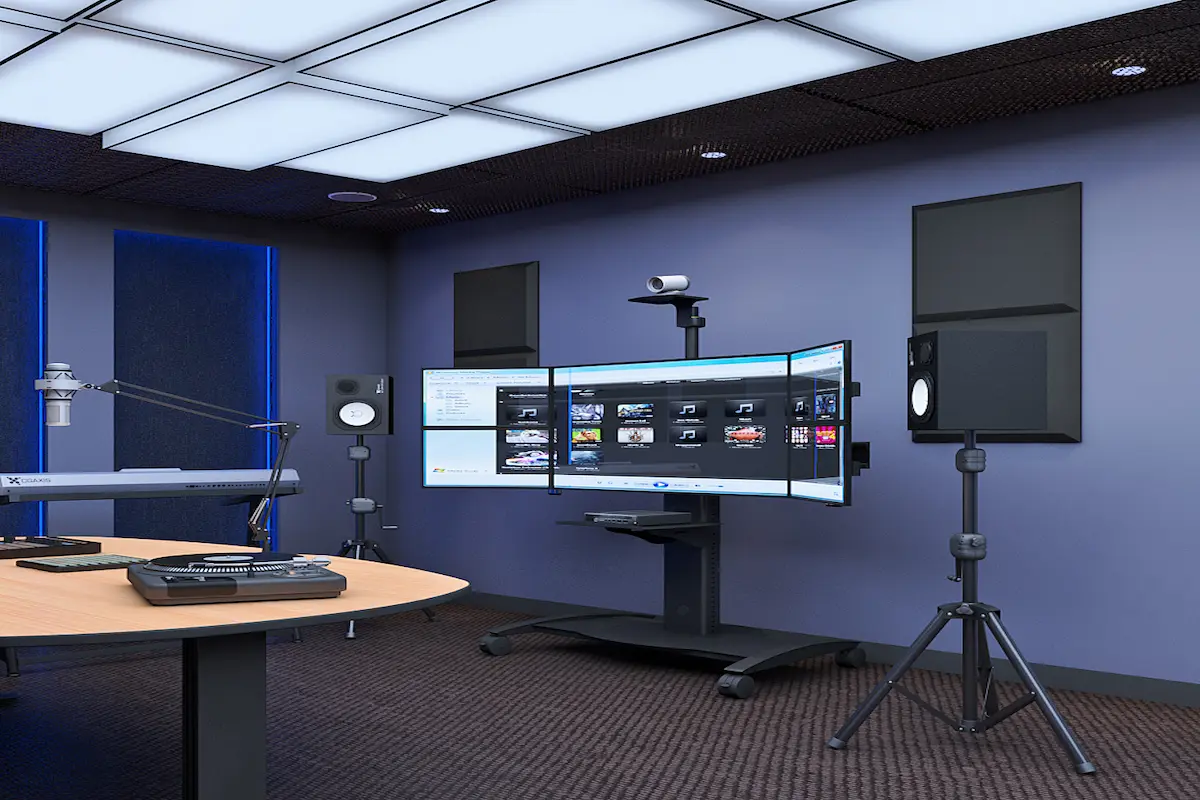
Audio visual equipment refers to the hardware and systems that capture, process, transmit, and present both sound and visual content. For Pennsylvania businesses, schools, and healthcare facilities, the right AV equipment transforms how teams communicate, learn, and collaborate.
This guide covers everything you need to know about selecting and implementing audio visual solutions in PA. We’ll explore core components like microphones, speakers, projectors, and screens. Additionally, we’ll examine audio visual furniture options and discuss real-world applications. Whether you’re outfitting a conference room or upgrading classrooms, this resource speaks directly to your needs.
What exactly is audio visual equipment? Simply put, it includes devices for sound (microphones, speakers, mixers) and visuals (projectors, monitors, video displays), along with the cables, adapters, and systems that connect them. Its primary purpose is to enhance communication clarity and audience engagement.
Here’s what you’ll gain from this article:
- Clear understanding of AV components and how they work together
- Knowledge of applications across conference rooms, classrooms, and healthcare
- Practical selection criteria for scalable, integrated systems
- Awareness of audio visual furniture and housing solutions
- Solutions to common challenges PA businesses face
Understanding Audio Visual Equipment Fundamentals
Audio visual equipment forms the backbone of modern communication. From presentations to video conferencing, quality AV systems ensure your message reaches your audience clearly. The global AV hardware market reached $257.2 billion in 2023 and is projected to hit $450.4 billion by 2032. This growth reflects how essential these systems have become.
Core Audio Components
Microphones capture sound, and there are several types to consider. Dynamic microphones work well for live speech, while condenser mics excel in recording settings. Lavalier mics offer presenter mobility, and ceiling arrays capture voices across entire rooms.
Speakers and amplification deliver that sound to your audience. You’ll find powered and passive options, along with line arrays for large spaces. Digital signal processing (DSP) ensures clean, feedback-free audio. Mixers—both analog and digital—help you balance and route audio signals. Consequently, choosing the right components directly impacts communication quality.
Visual Display Systems
Projectors remain important in many settings, especially large classrooms and auditoriums. Modern options include DLP, LCD, and laser projectors with varying brightness levels (measured in lumens) and resolutions up to 8K. Laser projectors require less maintenance and offer longer lifespans.
Monitors and digital displays have evolved significantly. LED, LCD, and OLED screens provide crisp visuals for conference rooms and classrooms. Video walls create immersive experiences for larger audiences. Furthermore, interactive touch displays enable collaboration and engagement.
Screens matter too. Fixed, motorized, and portable options each serve different needs. Consider factors like gain, surface type, and ambient light when making your selection.
Audio Visual Furniture and Housing Solutions
Proper housing protects your investment and ensures optimal performance. Audio visual cabinets furniture must accommodate equipment depth—typically 18-20 inches minimum for receivers—plus cable clearance. Ventilation is critical; without adequate airflow, components overheat and fail prematurely.
Media carts offer mobility for shared spaces. Look for models with height adjustment, cable management, and locking wheels. AFC Industries PA offers audio visual furniture solutions designed specifically for these demands.
Housing solutions also include wall mounts, ceiling mounts, and built-in furniture. Clean cable management and matching décor create professional environments. ADA compliance considerations—like display height and accessible controls—shouldn’t be overlooked.
Audio Visual Solutions for Different Applications
Building on these fundamentals, let’s examine how AV equipment serves specific environments across Pennsylvania.
Conference Room Audio Visual Equipment
Today’s conference rooms must support hybrid meetings seamlessly. Video conferencing systems like Zoom Rooms and Microsoft Teams Rooms have become standard. PTZ cameras with automatic tracking follow presenters around the room. Multiple microphones—table mics or ceiling arrays—capture every voice clearly.
Visual displays typically include large flat panels or dual monitors. Wireless presentation systems allow anyone to share content without cables. Lighting control and acoustic treatment complete the professional environment. For PA businesses in older buildings, retrofitting may require creative solutions for network and power infrastructure.
Educational Institution AV Systems
Classrooms are evolving rapidly. Interactive flat panels (65-86 inches) with multi-touch capability have largely replaced traditional projectors in smaller spaces. Lecture capture systems enable hybrid learning models that proved essential in recent years.
Sound reinforcement ensures students hear clearly, regardless of classroom size. Ceiling speaker arrays distribute audio evenly. Integration with learning management systems (LMS) streamlines content delivery. Pennsylvania schools benefit from flexible furniture designs that allow easy reconfiguration for different teaching styles.
Healthcare and Professional AV Integration
Healthcare facilities present unique requirements. High-resolution displays support medical imaging. Telehealth rooms need quality video cameras and secure audio systems that protect patient privacy.
Integration with building systems—paging, alarms—is essential. Infection control drives material choices for easy-to-clean surfaces. HIPAA compliance influences microphone and speaker placement to prevent audio leakage. These considerations make professional integration crucial.
Selecting and Implementing Audio Visual Equipment
With applications understood, let’s discuss how to select and implement the right solutions.
AV Equipment Assessment Process
Before purchasing any equipment, conduct a thorough assessment. Here’s the process:
- Space evaluation: Measure dimensions, assess ambient light, check acoustics, and document existing infrastructure
- User requirements analysis: Determine participant counts, content types, and ease-of-use requirements
- Budget planning: Consider capital costs, maintenance, licensing, and lifecycle expenses
- Technology compatibility review: Ensure network readiness and future-proofing for emerging standards
Audio Visual Furniture vs Integrated Solutions Comparison
Choosing between standalone furniture and integrated solutions depends on several factors:
|
Factor |
Standalone Furniture |
Integrated Solutions |
|
Initial Cost |
Lower; minimal construction |
Higher; custom design required |
|
Flexibility |
Easily moved and reconfigured |
More fixed; constrained adaptations |
|
Installation |
Minimal permitting needed |
Requires design and structural work |
|
Scalability |
May run out of capacity |
Designed for growth |
For businesses just starting out, standalone audio visual furniture offers flexibility. Meanwhile, established organizations often benefit from integrated solutions designed for long-term use. Explore options at AFC Industries PA’s shop to find what fits your situation.
Common Audio Visual Equipment Challenges and Solutions
Even well-planned implementations face obstacles. Here’s how to address common issues.
Equipment Compatibility Issues
Mismatched signal types and resolutions cause headaches. Troubleshooting these problems wastes valuable time. The solution? Insist on standard protocols like Dante for audio and AV-over-IP for video distribution. Test cross-brand compatibility before installation. Use quality cables and adapters from reputable sources.
Space and Installation Constraints
Pennsylvania’s older buildings often present space limitations—low ceilings, limited conduit access, structural constraints. Ultra-short-throw projectors work in tight spaces. Ceiling-mounted speakers save floor space. Surface raceways provide cable paths without invasive construction. Contact AFC Industries PA for guidance on space-constrained installations.
Budget and Scalability Concerns
High initial costs concern many organizations. Phased implementation offers a solution: start with essential components, then add features over time. Choose modular systems that accept upgrades. Consider leasing or subscription models for flexibility. Most importantly, plan for standard connectors to avoid proprietary lock-in.
Conclusion and Next Steps for Your AV Project
Quality audio visual equipment enhances communication, boosts engagement, and supports success across any setting. Whether you’re providing for a conference room, classrooms, or healthcare facility, the principles remain consistent: assess needs thoroughly, select components carefully, and implement with future growth in mind.
Here are your next steps:
- Assess current needs by evaluating spaces and user requirements
- Contact AV professionals at AFC Industries PA for expert guidance
- Plan your installation timeline with realistic milestones
Consider exploring ongoing maintenance requirements and system update schedules as you move forward with your project.
Frequently Asked Questions
What is the difference between professional and consumer AV equipment?
Professional audio visual equipment offers better build quality, extended warranties, and commercial-grade signal standards. AFC Industries PA provides professional-grade solutions designed for demanding business environments.
How deep should an AV cabinet be for my equipment?
Most AV receivers require 18-20 inches of internal depth, plus cable clearance. Proper ventilation on sides and back is essential. Our audio visual cabinets furniture accounts for these requirements.
What AV equipment do I need for a conference room?
Conference room audio visual equipment typically includes displays, cameras, microphones, speakers, and collaboration tools. The exact setup depends on room size, participant count, and meeting types.
How do I ensure ADA compliance with AV installations?
Consider display height and reach requirements, accessible controls, and hearing assistance systems. AFC Industries PA can help you meet these important standards.
What maintenance does AV equipment require?
Regular maintenance includes filter cleaning, firmware updates, cable checks, and calibration. Proper housing and ventilation reduce maintenance needs significantly.
Where can Pennsylvania businesses find quality AV solutions?
AFC Industries PA, located in Berwick, Pennsylvania, offers comprehensive audio visual solutions including furniture, racks, mounts, and integration services for local businesses.